Claus Hetting, WiFi NOW CEO & Chairman
Snapdragon Summit, Maui, Hawaii, September 23, 2026: Mobile platforms of course continue to be the mainstay of Qualcomm’s Snapdragon business – but ‘Personal AI’ platforms are now commanding increasing amounts of attention. A flurry of Snapdragon-powered smart glasses plus plenty of other innovative form factors took centre stage on Day Two of this year’s Summit – while Qualcomm’s new Sound Elite Gen 2 platform introduces ‘micro-power Wi-Fi’ to a new generation of intelligent audio wearables.
After this week’s Summit, Agentic AI-based Snapdragon mobile platforms arguably need little further introduction – but while smartphone evolution towards agentic AI architectures is mostly business as usual, the same cannot be said of the slew of new-form-factor ‘Personal AI’ devices on display this week at the Snapdragon Summit. Qualcomm is betting big on Personal AI platforms spanning audio devices, watches and other wearables, smart glasses, and immersive XR – and this week added the new Snapdragon Sound Elite Gen 2 to the portfolio.
The Sound Elite Gen 2 is Qualcomm’s latest audio-focused Personal AI platform, presented with gusto by Ziad Asghar, Qualcomm Senior Vice President and General Manager of XR, Wearables, and Personal AI. And while Qualcomm offers the full gamut of wearable platforms, this one is specifically aimed at – for example – audio-only smart glasses, earphones, headphones, or even AI pendants.

“As AI becomes a core capability, users will increasingly expect more natural ways to interact with it. Those interactions won’t always happen through a screen. They will happen through natural conversations, where users can simply speak to an AI assistant and receive help in real time,” Ziad Asghar said at the event. The new platform offers both direct-to-Cloud connectivity and on-device AI for applications such as real-time translation, contextual assistance, personalised hearing, and multimodal interactions that combine audio, vision, and AI, Qualcomm says.
As is typical at events of this type, the connectivity layer tends to get little attention – but Qualcomm’s ‘micro-power Wi-Fi’ is far from trivial. The integrated Wi-Fi 6E (tri-band) capabilities features a maximin PHY rate of 86 Mbps (as reported by AudioXPress here) including – Qualcomm says – power reduction of up to 40% compared to the previous generation. And while Qualcomm also provides Bluetooth connectivity on the platform, micro-power Wi-Fi means designers have a viable – and in some cases preferable – alternative when it comes to choosing a wireless technology for their wearable.
Also significant is that Wi-Fi allows the wearable to communicate directly to the Cloud without using a phone as an intermediary, which would be the case with Bluetooth. Now add to this Qualcomm’s XPAN technology, which intelligently manages whether Bluetooth or Wi-Fi is preferred, for example by switching from Bluetooth to Wi-Fi for extended range. XPAN even allows for example earbuds to connect via ordinary Wi-Fi routers in the home or office with no Wi-Fi infrastructure changes required, Qualcomm says. The technology also supports up to 192 kHz lossless audio streaming over micro-power Wi-Fi.
Meanwhile, there was no shortage of slick and innovative device previews at the Summit. Notable were a slew of new smart glass products from the likes of SPECS, INSPECS, and of course Meta.
Qualcomm’s broader Personal AI and XR portfolio now spans multiple platforms including Snapdragon Wear Elite for watches and other wearable form factors, Snapdragon AR1 Gen 1 and AR2 Gen 1 for smart and augmented-reality glasses, and Snapdragon Reality Elite, the company’s flagship spatial-computing platform announced earlier this year. The connectivity architectures differ according to the power, performance, and form-factor requirements of each category, ranging from micro-power Wi-Fi in small wearables to high-performance Wi-Fi connectivity for AR and XR.
Separately, at Meta Connect 2026 – also taking place on September 23 – Meta announced multiple new glasses products, including Ray-Ban Meta Gen 3, the new camera-free Ray-Ban Meta Audio, Meta VR Glasses, and more.
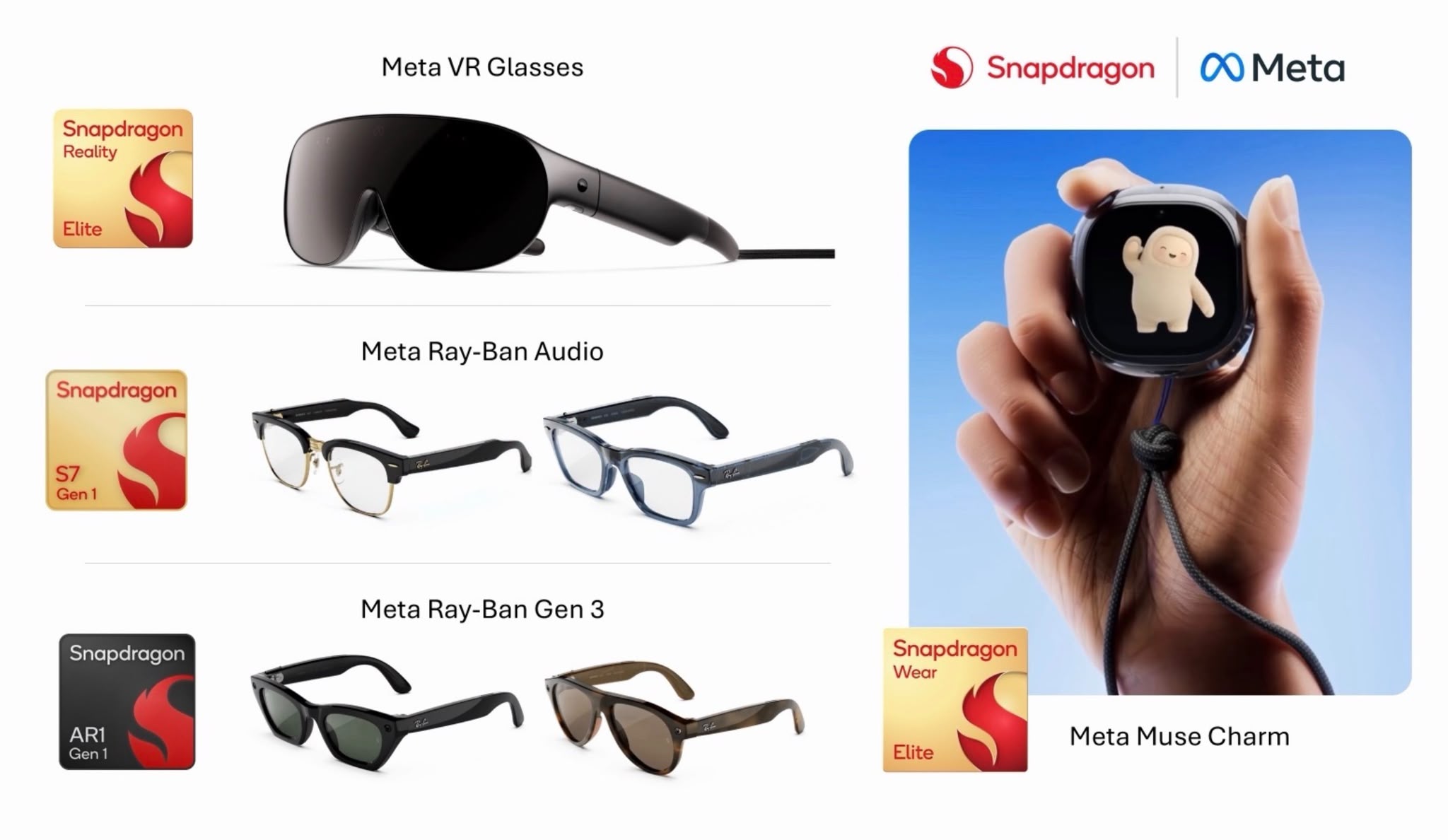
It is clear that the floodgates are opening for ‘Personal AI’, and Qualcomm is positioning Snapdragon silicon across an unusually broad range of emerging device categories. Ultimately, a significant part of the market could opt for non-camera devices – such as audio-only glasses – since they are less obtrusive while still delivering many of the benefits of agentic AI through natural voice interaction and audio.
/Claus.