By Claus Hetting, WiFi NOW CEO & Chairman
At COMPUTEX 2026 in Taiwan last week, silicon vendor Synaptics showcased what it describes as one of the industry’s first single-chip AI microcontrollers (MCUs) with integrated Wi-Fi 7 connectivity. The new platform creates significant opportunities for device manufacturers to embed intelligence directly into devices, enabling on-device AI as a complement to—or, in some cases, a viable alternative to—cloud-based AI processing.
While many AI workloads continue to run in data centres, a growing number of technology vendors see AI at the edge as a powerful complement to today’s cloud-centric architectures. Running AI locally can reduce latency, improve privacy, lower bandwidth requirements, and enable real-time decision-making in connected devices. These are all important features for the next-generation connected home.
Synaptics is among the companies betting heavily on this trend. At COMPUTEX last week, the company showcased its new Astra™ SRW1500 AI MCU, which integrates advanced AI processing capabilities with built-in Wi-Fi 7 connectivity on a single chip. According to Synaptics, high-performance Wi-Fi 7 is a critical enabler of next-generation edge AI applications. The Astra™ SRW1500 AI MCU was launched earlier this year at Embedded World in Germany (read more here).
While inference is performed locally, many edge AI devices still need to exchange data, software updates, model parameters, or contextual information with cloud services and other devices. Synaptics believes Wi-Fi 7 delivers the performance needed to make that interaction seamless.

“Unlike previous Wi-Fi generations, Wi-Fi 7 combines multi-gigabit throughput with predictable low-latency performance, making it better suited to AI applications that must process and exchange data in real time. The combination of low-latency embedded AI and Wi-Fi 7 will unlock a new generation of smart cameras, industrial sensors, consumer devices, and other connected products that in large part are capable of making decisions locally rather than relying mostly on cloud-based AI processing. With this platform, it will be possible to balance local processing and cloud interaction flexibly and in the right way, depending on the application,” says Ananda Roy, Senior Product Line Manager at Synaptics.
Since early this year, Synaptics has been positioning itself as a leading supplier of high-performance Wi-Fi 7 silicon for IoT applications. The SRW1500 marks the company’s first product that combines Wi-Fi 7 connectivity with a single-chip AI microcontroller. “IoT is evolving from data-gathering to a continuous intelligence loop, where devices sense and respond in real time. The SRW1500 AI microcontroller draws on the power of Wi-Fi 7 to deliver both the ultra-responsive connectivity and fast inferencing needed to deliver next-generation AI services, for example within the home,” he says.
The SRW1500 combines an Arm Cortex-M52 processor with 1 MB of on-chip SRAM and an Arm Ethos-U55 NPU, delivering up to 50 GOPS of processing performance. The new platform also incorporates Thread (for Matter compatibility), Bluetooth Low Energy 6.0, as well as a comprehensive suite of hardware-based security features. The latter is particularly important as security becomes both a key driver and a critical requirement for AI at the edge, the company says.
“One of the main drivers pushing AI-based services towards the edge is the need to maintain home security and protect privacy. In many cases, sending data from the home to the cloud is simply a non-starter. Many home IoT use cases involve personal and highly sensitive data streams. We’ve built the SRW1500 from the ground up for robustness against a new generation of threats,” Ananda Roy says.
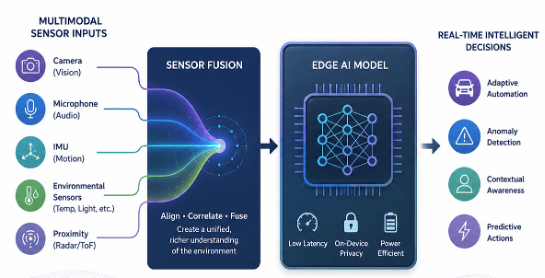
Synaptics says target markets for the SRW1500 include smart appliances, smart home automation, and industrial IoT. One of the platform’s most innovative features is support for multimodal data integration, which combines data from cameras, microphones, motion detectors, environmental sensors, and proximity sensors. Using this capability, vendors will be able to develop contextually aware AI-based devices and services, Synaptics says.
/Claus.