
By Claus Hetting, WiFi NOW CEO & Chairman
Are wireless architectures ready to support more than 60 intelligent IoT devices per household by 2030? It’s a tall order. According to Synaptics, meeting this demand will require a shift toward high-performance Wi-Fi combined with real-time AI at the edge and stricter security. In short, wireless is evolving from simple connectivity to connected intelligence, Shishir Gupta said at WWC Mountain View.
The number of IoT devices per home is rising with many households expected to exceed 60 devices within the next five years. Add to this the growing role of edge AI – as well as the need for far stricter security – and the pressure on today’s wireless infrastructure becomes clear. As a result, a new class of high-density, high-performance IoT architecture is emerging, said Shishir Gupta, VP of Product Marketing and Customer Engineering at Synaptics, speaking at this year’s Wi‑Fi World Congress.

“Wi-Fi is the invisible backbone of the hyper-connected household – and this backbone needs to deliver exceptional low latency connectivity, otherwise AI will simply not work. It is about creating an outstanding user experience within the home while at the same time protecting data and privacy, which means much more strict security is required. In short, the paradigm is shifting from connectivity only to intelligent, interconnected IoT systems. This means we have to rethink and redefine wireless IoT architectures,” Shishir Gupta said.
As the connected home evolves, reliability and high QoS becomes critical also for IoT systems. The introduction of AI and more sophisticated IoT systems handling sensitive data also means that risks from data breaches increase massively as a lapse in security could result in a direct physical threat to the household. “We’re talking about smart locks, smart meters, other forms of access control, perhaps medical telemetry, financial data, home security feeds, and more. One could argue that the true AI-powered hyper-connected home cannot happen in any appreciable form if security is not dealt with very carefully. Otherwise the risks would simply be too high and customers would not accept them,” he said.
According to Synaptics, the right level of reliability and performance for a high-density Wi-Fi IoT environment is achieved by embracing the latest standards – including Wi-Fi 7 – which adds MLO for QoS, preamble puncturing for interference resilience, as well as wider channels for more capacity. Synaptics was the first to deliver an IoT-optimised Wi-Fi 7 platform in April of last year (read more here).
For stricter security, a range of new protocols (previously found mostly in enterprise networking) are key including anonymised PMKID (Pairwise Master Key Identifier) to protect passwords, encrypted flows, WPA3 client isolation (restricting peer-to-peer links when devices are authenticated on shared SSIDs), and more. Wi-Fi-only Matter provisioning (provisioning without Bluetooth) also has a role to play in reducing security risks in connection with onboarding, Shishir Gupta said.
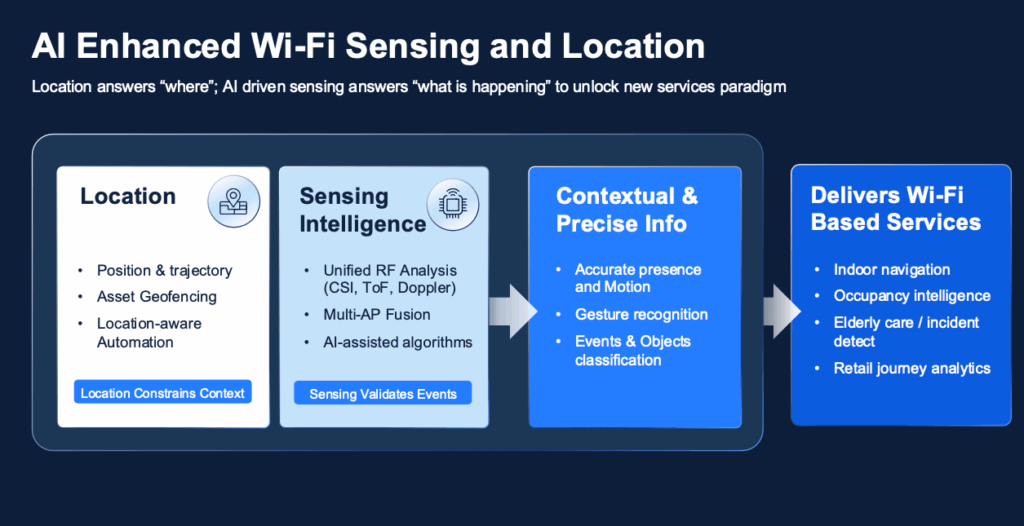
Meanwhile, Synaptics believes that AI is becoming a key building block for Wi-Fi and networking generally in a number of areas. “AI delivers much better Wi-Fi performance tuning – and especially for the new and more complex standards including Wi-Fi 8, AI will be instrumental in optimising RF configurations, for example. On the security side AI is powerful when it comes to proactive threat mitigation and – for example – preventing ‘side door’ entries into the home network,” he said.
Perhaps even more consequential is the role of AI in enabling sophisticated new Wi-Fi sensing and location services. “The position and trajectory accuracy of a device will be enhanced while sensing data from CSI, time-of-flight, and Doppler methods can be combined. All of this allows accurate determination of presence and motion, even gesture recognition, and classification of objects. Ultimately, new Wi-Fi-based services will be possible including indoor navigation, occupancy detection, retail journey analytics, and more,” said Shishir Gupta. For more about Synaptics’ Wi-Fi 7 platform also read here.
/Claus.