By Claus Hetting, WiFi NOW CEO & Chairman
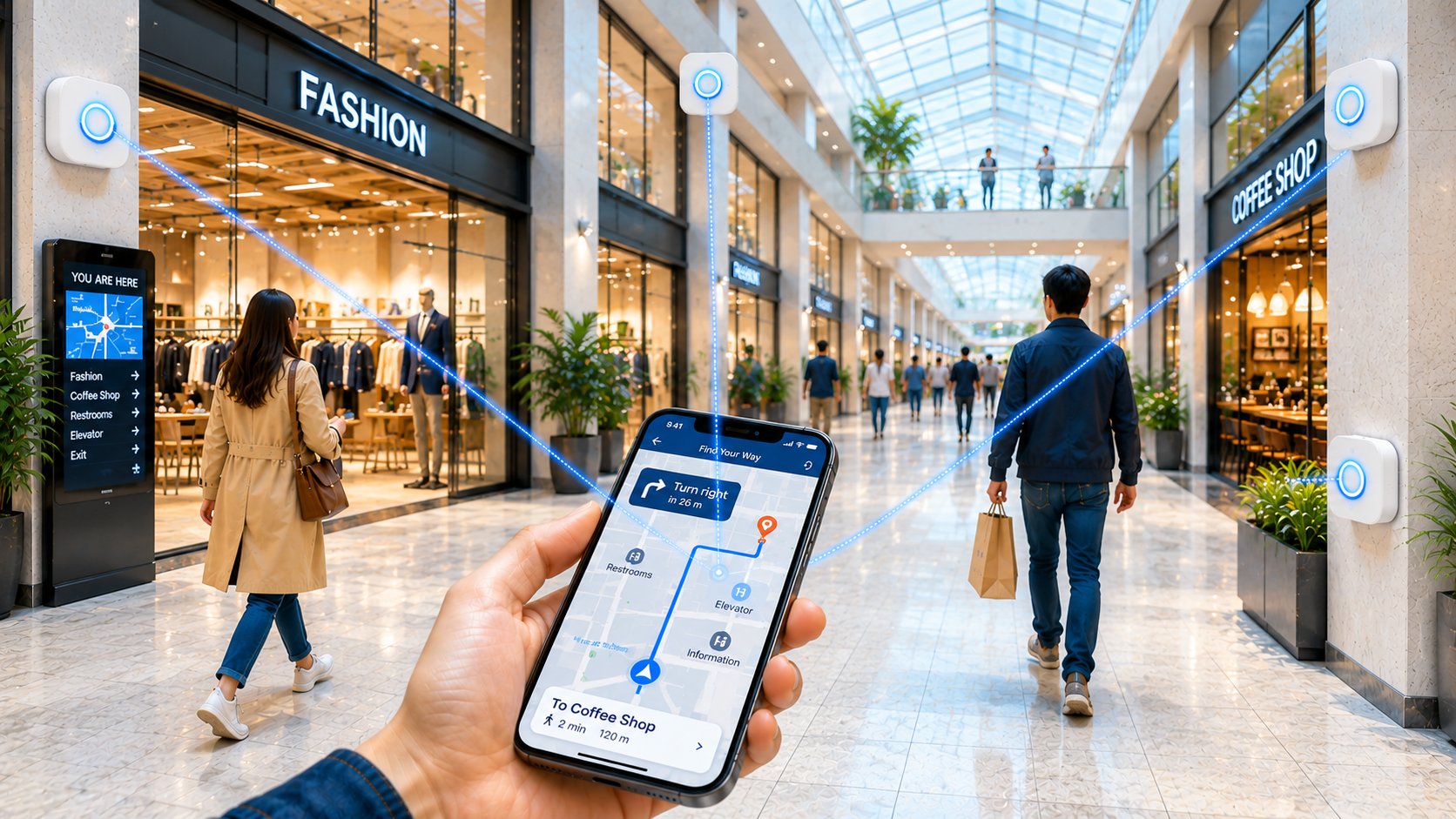
Ultra-wideband ranging technology – already present in millions of phones and newer Wi-Fi infrastructure – promises centimetre-level accuracy that when implemented, could lead to extremely accurate indoor location services and host of valuable use cases for a variety of venues. Now both Apple and Google are taking the next steps towards enabling mass market GPS-style wayfinding for every phone and indoor location.
Since we began covering UWB in detail in 2025, it has become clear that accurate indoor location – where the phone determines its own position rather than being tracked by the infrastructure – is on the cusp of a breakthrough. But as always the devil is in the detail when it comes to establishing the full ecosystem support required for mass market adoption. The good news is that recent releases and documentation from Android and Apple are now – each in their own way – reinforcing the two companies’ intent on making indoor wayfinding happen.
UWB in Apple iOS27
Apple has taken the first step towards a broader UWB ecosystem by releasing an interoperability specification for chipset vendors. On June 8 the company released a so-called ‘developer preview’ specification alongside documentation for upcoming iOS27, and commercial implementations are expected to follow. Apple is encouraging UWB chipset vendors to begin adopting the specification so that products can interoperate with iOS devices and Apple’s ‘Nearby Interaction’ framework. No UWB chipset vendor has yet publicly confirmed implementation of the iOS 27 specification.
Apple does not explicitly position the new specification as an indoor positioning initiative, but it could become an important building block for interoperable UWB infrastructure capable of supporting future large-scale indoor navigation and positioning. While Apple’s ‘Nearby Interaction’ API has been available since iOS 14, the new interoperability spec is a different kind of milestone. Instead of targeting application developers, Apple is now encouraging UWB chipset vendors to implement a common interoperability model for future Apple-compatible UWB products.
Join Pinpoint & WiFi NOW at the first open UWB event in Europe: On October 29, the UWB global leaders are coming together under one roof for an in-person deep-dive into the technology and business opportunities of ultra-wideband location and asset tracking. UWB in Action is your fast track, one-day knowledge and networking conference design to making UWB happen in Europe and everywhere.
Click here for more information.
UWB in Android 17
Meanwhile, the news from Android might be even better: As of June this year, Android has made a new DL-TDoA API available to developers alongside the Android 17 release. Native support for DL-TDoA is an important step towards mass-market indoor positioning because it allows Android devices to determine their own position relative to compatible UWB infrastructure while preserving user privacy.
DL-TDoA (Downlink Time Difference of Arrival) enables the phone to calculate its own position from timing measurements transmitted by UWB anchors. This privacy-by-design approach means the infrastructure does not need to know where the phone is. As always, the Android API offers considerably more control of the UWB stack compared to the Apple API, which essentially offers access to distance, direction, and nearby interaction.
Taken together, the two announcements suggest that Apple and Google are independently laying important foundations for a broader, interoperable UWB ecosystem. If chipset vendors, infrastructure providers, and venue operators adopt these capabilities, truly universal indoor GPS-style navigation could move significantly closer to reality.
/Claus.