By Claus Hetting, WiFi NOW CEO & Chairman
Ultra-wideband (UWB) technology is rapidly expanding beyond digital car keys and consumer devices into indoor navigation, retail, enterprise networking, and industrial applications. This week’s UWB in ACTION conference in Chemnitz, Germany, brought together leading technology companies and end-users to explore the next phase of commercial UWB adoption.
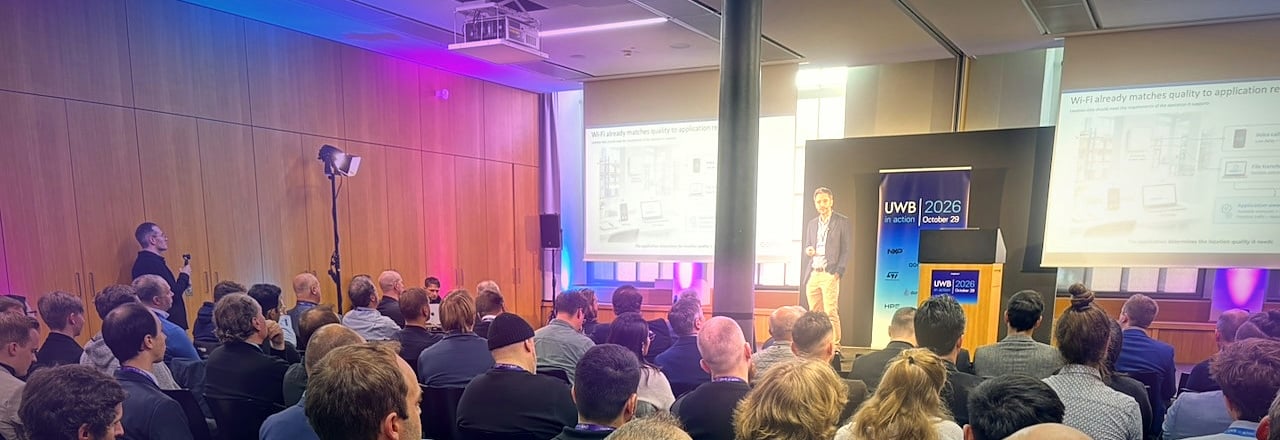
The growing commercial momentum behind ultra-wideband (UWB) technology was the central theme of UWB in ACTION 2026, held October 29 at Chemnitz University of Technology in Germany. The event – organised by German UWB specialist Pinpoint in cooperation with WiFi NOW – brought together silicon vendors, enterprise networking companies, standards organisations, and end-users to explore how precise indoor positioning is moving into mainstream commercial applications.
Among the participating companies were Qorvo, NXP, STMicroelectronics, Infineon, HPE, and SICK, alongside industry organisations and market analysts. One of the event’s central themes was the growing use of UWB for indoor navigation and location-based services. Germany’s national railway operator Deutsche Bahn presented its vision for seamless passenger navigation, while Schwarz Group’s technology organisation Schwarz IT addressed precise positioning applications in retail and smart spaces.
These applications illustrate how UWB’s highly accurate ranging capabilities can enable services that conventional GPS cannot reliably deliver indoors, potentially creating new opportunities in transportation hubs, shopping centres, public venues, and enterprise environments.
Importantly, UWB can deliver centimetre-level positioning accuracy enabling – for example – industrial and physical AI applications where knowing an approximate location of a device or person is not enough. The technology also supports secure proximity detection – for example for public and occupational safety where robots and human workers interact – and precise interaction between connected devices and their physical surroundings. Finally, indoor wayfinding with UWB is inherently protects privacy in that your phone will know your location, but the network will not.
“The potential for UWB to transform how people work and live as well as the operational efficiency of industries is huge – we saw this in Chemnitz this week. The use cases are real, and they are proven. UWB is in the process of fulfilling many promises that so far, Bluetooth and Wi-Fi have been unable to deliver at scale. In a few years we will look back at UWB in ACTION this week in Chemnitz as the inflection point where UWB and its applications became very real,” said Claus Hetting, CEO & Chairman of WiFi NOW, & co-organiser of UWB in ACTION.
From precise positioning to intelligent spaces
The conference also explored the role of UWB in emerging intelligent environments, including industrial automation, robotics, and physical AI. NXP addressed the evolution from precise location to intelligent motion, while HPE examined how UWB infrastructure can support enterprise applications. SICK and the omlox ecosystem focused on interoperable positioning solutions for industrial material flows, where accurate tracking of equipment, assets, and goods can improve operational efficiency.
The convergence of UWB with enterprise wireless infrastructure is particularly interesting. While Wi-Fi provides the connectivity backbone for enterprise devices, UWB adds a precise spatial awareness layer, enabling new services for buildings, factories, hospitals, and large public venues. Meanwhile, STMicroelectronics highlighted opportunities emerging from IEEE 802.15.4ab, the next-generation UWB standard designed to extend the technology’s capabilities and support new applications.
Another important development is the opening of UWB capabilities to third-party developers by Apple and Google, potentially accelerating adoption through smartphones and other connected devices. The event also featured hands-on demonstrations and workshops covering mobility, entertainment, retail, and industrial tracking. The event was well attended with a full house at the Chemnitz University Library.
The broader message from Chemnitz is that UWB is becoming more than a specialised positioning technology. As standards mature, infrastructure expands, and smartphone ecosystems become more accessible, UWB is on track to becoming an increasingly important component of intelligent spaces alongside Wi-Fi, Bluetooth, and other wireless technologies – and in many cases even supersede some of these technologies when it comes to accurate location and positioning. For the industry, the next challenge is translating that technological potential into scalable deployments with compelling business cases.
/Claus.