By Claus Hetting, WiFi NOW CEO & Chairman
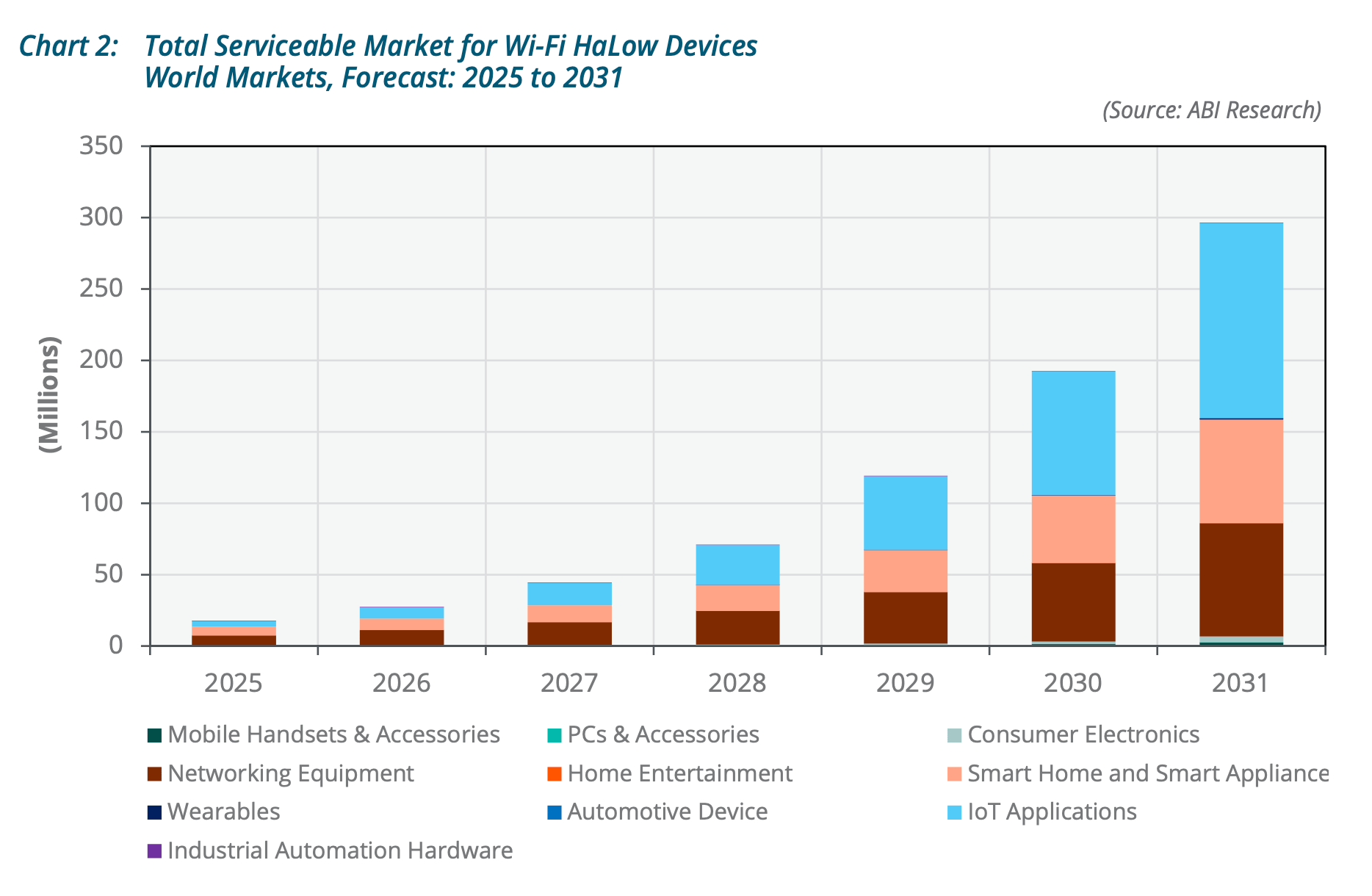
New research from ABI Research points to a dramatic expansion of the Wi-Fi HaLow market, with its serviceable addressable market expected to grow at more than 60% annually to reach 297 million devices by 2031. Driven in large part by chipset pioneer Morse Micro, the Wi-Fi HaLow ecosystem has expanded significantly in recent years. The new findings suggest the technology could be approaching a major commercial breakthrough.
Still unsure about the future of Wi-Fi HaLow? The lesser-known Wi-Fi standard designed for long-range, low-power IoT connectivity – and increasingly edge AI – has so far seen relatively modest commercial adoption. But that could soon change. A new report by ABI Research – authored by Principal Analyst Andrew Spivey – suggests Wi-Fi HaLow is entering a period of potentially explosive market growth as the technology expands beyond its initial footprint.
ABI Research estimates that Wi-Fi HaLow’s total addressable market (TAM) represents nearly 10 billion annual device shipments in 2026, increasing to 14.3 billion by 2031. More significantly, the serviceable addressable market (SAM) for Wi-Fi HaLow is expected to grow from 27 million devices this year to 297 million in 2031 – representing a compound annual growth rate of approximately 62%.
The opportunity is concentrated in three major segments: IoT applications, smart home devices, and networking equipment. One of the important drivers of this expansion is the potential for Wi-Fi HaLow infrastructure to support multiple applications once deployed, ABI Research says.
“Once Wi-Fi HaLow infrastructure has been embedded in an environment for an initial application, the additional cost for enabling further Wi-Fi HaLow applications is marginal, so Internet Service Providers (ISPs) and enterprises will be incentivised to expand Wi-Fi HaLow to further applications to improve operational efficiencies and boost ROI,” Andrew Spivey writes in the report.
Greater diversity of devices in the pipeline
ABI Research expects the diversity of Wi-Fi HaLow-enabled smart home devices to increase significantly after 2028. While security cameras, smart doorbells, and smart lighting are expected to account for a substantial share of the market, adoption could broaden to include connected door locks, garage door sensors, environmental sensors, and numerous other applications.
Smart metering is another important growth opportunity identified in the report. Industrial automation and Wi-Fi HaLow-enabled smartphones and smartphone adaptors are also expected to contribute, although these will remain comparatively small market segments, ABI Research says.
Wi-Fi HaLow silicon leader Morse Micro – a WiFi NOW Partner and multiple WiFi NOW Awards winner – has been a principal architect behind establishing the Wi-Fi HaLow ecosystem, which now consist of a full range of module and device makers as well as development partners. Chipmaker Newracom has also contributed to expanding the ecosystem.
For more details on Wi-Fi HaLow technology and ecosystem, see our comprehensive Resource Centre coverage here. Also don’t miss our November 3 Industry Update Webinar on Wi-Fi HaLow for Europe – register to view and a participate here.
We will post a link to the full ABI Research report here as soon as it is available.
/Claus.