Wi-Fi HaLow update 08/25: Revisiting distance records, Morse Micro wins award, & more HaLow products released
| Wi-Fi HALOW UPDATE | by Claus Hetting, Wi-Fi NOW CEO & Chairman
By Claus Hetting, WiFi NOW CEO & Chairman
Wi-Fi HaLow is coming of age fast – which is why at WiFi NOW, we’re ramping up our support of the growing and dynamic Wi-Fi HaLow community. Starting from this month we will be providing bi-monthly (or at least monthly) updates on the most important developments in Wi-Fi HaLow including news about product releases, case stories, analysis, and more. If you are a WiFi HaLow vendor, developer, or end user and want to be part of our new Wi-Fi HaLow information service, contact us now.
Revisiting Wi-Fi HaLow distance records: How far – and how fast?
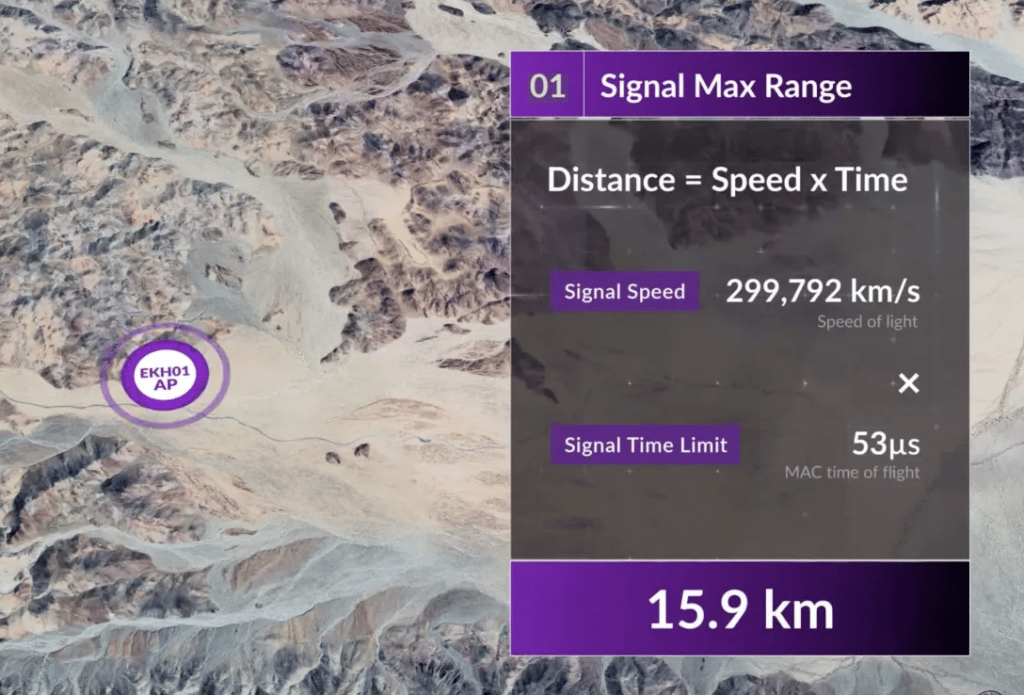
Last year in July Newracom & Teledatics smashed Wi-Fi HaLow distance record with staggering 66 mile connection delivering 1 Mbps of data rate. Since then Morse Micro followed up by delivering 2 Mbps video connectivity across close to 16 kilometres at Joshua Tree National Park in California (read more about the Joshua Tree demo here) using standard equipment. The Morse Micro field test verified the 802.11ah standard’s theoretical limit at 15.9 kilometres.
Comparing the two sets of results is a little like comparing apples and oranges since the configurations were different: The Teledatics test used Teledatics own TD-HALOM Wi-Fi HaLow module with 1 Watt (30 dBm) output power, while Morse Micro used their MM6108-EKH01 evaluation kit at 22 dBm. You can read more about the Teledatics test here.
Above: Results from Morse Micro’s field trial at Joshua Tree National Park in California.
But both tests show the tremendous range potential of Wi-Fi HaLow technology and its amazing versatility when it comes to designing long-range wireless IoT networks. What configuration you use and what distance you need to traverse will of course depend on specific use cases (although the longer the range, the lower the data rate). Still the capabilities of the technology are clear and applications are many and expanding, Teledatics says.
“Right now we’re seeing connectivity demand for long-distance drone control and video transmission as well as in agriculture. Additional range can be achieved by upping the power to two or four Watts although this of course only in regions where regulatory approval is possible. Currently, our 1 Watt version is ready to be certified by the FCC for use within the USA,” says Chris King, sales manager at Teledatics. The company’s Wi-Fi HaLow portfolio also includes M.2 cards and an M.2 developer kit.
Most vendors of Wi-Fi HaLow equipment cite 1-2 kilometres at a couple of Mbps of speed as the typical range/speed for off-the-shelf equipment but that is in many cases enough to carry streamed video. Wi-Fi HaLow can be extended using the standard’s own mesh capabilities but this does ultimately limit possible data rates as throughput will be reduced for very hop.
Newracom: Wi-Fi HaLow as an ultra-low power IoT technology
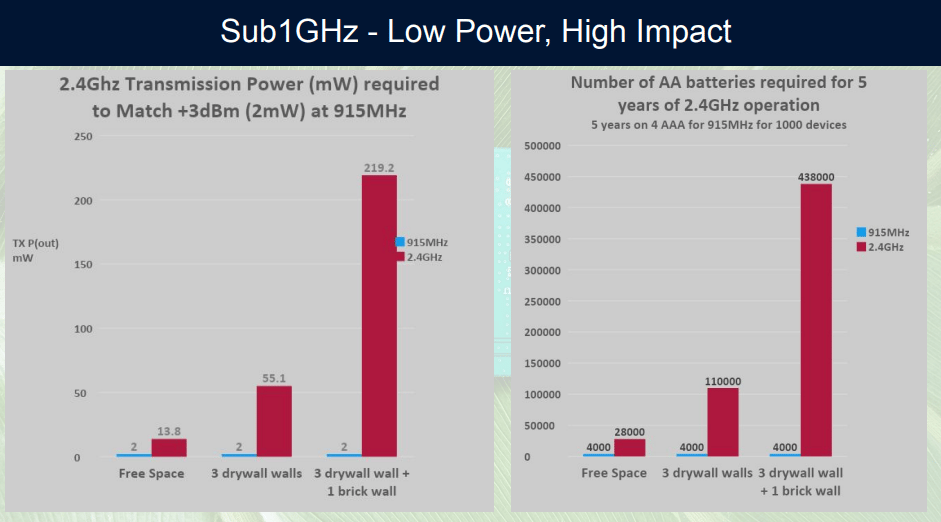
You can view Wi-Fi HaLow as a long-range IoT technology – and that would not be wrong. But what about power consumption? Ultra-low power Wi-Fi IoT is a megatrend (we’ve covered it here) and as it turns out, sub-GHz Wi-Fi HaLow fits very nicely into this category, too. The chart below – courtesy Newracom – shows the massive additional power required at 2.4 GHz Wi-Fi to match sub-GHz Wi-Fi HaLow as well as a battery consumption comparison. Wi-Fi HaLow performs as an ultra-low power IoT technology in particular because sub-GHz frequencies penetrate walls much better than the usual Wi-Fi frequencies.
Above graphic courtesy Newracom.
Morse Micro wins yet another IoT award
Wi-Fi HaLow chipset leader Morse Micro is no stranger to awards, having won five consecutiveWiFi NOW Awards for Best Wi-Fi IoT Product. This time Morse Micro has landed the ‘2025 IoT Emerging Technology Award’ by IoTThinkTank announced on July 23. “Morse Micro’s flagship MM8108 chip is a technical marvel. It delivers industry-leading 37% transmit efficiency – nearly four times more efficient than typical Wi-Fi transmitters – without sacrificing performance, security (WPA3), or IP-level compatibility. This leap forward enables IoT devices to operate for years on a single battery while streaming data across vast distances,” IoTThinkTank says.
Is Wi-Fi HaLow track for 100 million devices in 2029?
ABI Research’s prediction from last year that 100 million Wi-Fi HaLow-enabled devices will hit the markets by 2029 is looking more and more likely: Wi-Fi HaLow products of all kinds are being released at an increasing rate and over the past months, signifying a growing and healthy ecosystem. End-user devices, modules, dongles, and development kits are all now widely available from a wide range of suppliers. Here’s a breakdown of how ABI Research sees emerging Wi-Fi HaLow use cases. The highly recommended full report can be downloaded here and is more valid than ever.
Airfide introduces Wi-Fi HaLow-connected building occupancy sensor
Above: Airfide’s new building occupancy sensor
Wi-Fi HaLow connectivity is powering a slew of innovative new use cases including this: IoT sensor company Airfide has just released a building occupancy sensor using Wi-Fi HaLow for long-range connectivity.
The company says Wi-Fi HaLow offers ten times the range compared to standard (non-HaLow) Wi-Fi “while maintaining ultra-low power and high reliability for commercial and industrial IoT deployments.” The sensor is powered by Morse Micro’s MM6108 Wi-Fi HaLow SoC and detects occupancy, presence, motion, falls events, and more using millimetre-wave radar and AI at the edge.
Modules & USB dongle from Vantron
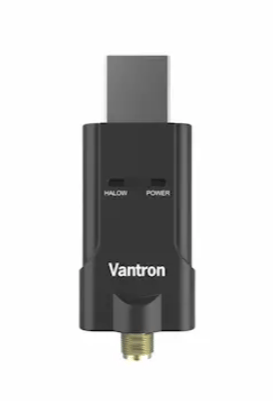
The latest Wi-Fi HaLow module to be released is Vantron’sVT-MOB-AH-8108, which does pretty much everything you would want a Wi-Fi HaLow module to do: It supports up to 43.3 Mbps with 8 MHz channels, has been designed for worldwide spectrum compliance, and can be used in either station or access point mode. Add to this that the module footprint is only 11 x 10 x 2.8 mm and that it already powers Vantron’s Wi-Fi HaLow USB dongle. Vantron’s Wi-Fi HaLow modules are equipped with Morse Micro’s MM8108 chipset.
Catalysts for market adoption
Modules and development kits are critical catalysts for the accelerated adoption of Wi-Fi HaLow as are USB dongles. Vantron’s dongle means that anyone can now retrofit their (regular) Wi-Fi network or client device with Wi-Fi HaLow technology, even if it is only initially to explore and familiarise themselves with the new technology. Also read this excellent blog on the subject by Morse Micro CEO Michael De Nil. If you simply want to test Wi-Fi HaLow capabilities without necessarily having to build anything then we also recommend Morse Micro’s HaLowLink 1.
Above: Gateworks’ recently released M2 Wi-Fi HaLow card for connecting single-board industrial computers.
New from Gateworks & Heltec Automation
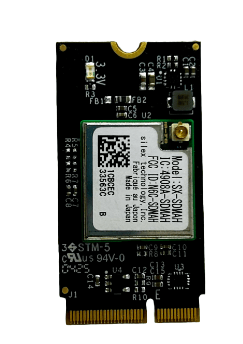
Meanwhile US-based Gateworks continues to bring Wi-Fi HaLow to market citing Wi-Fi HaLow as ‘the new backbone of industrial IoT’. Gateworks – a world leader in industrial single-board computers – now offers the GW16159 802.11ah Wi-Fi HaLow M.2 Radio card (released in June) as well as as the GW11056 development kit. With a range of up to 1 kilometre, Gateworks says Wi-Fi HaLow is perfect for smart factories, smart transportation, and smart energy. Gateworks’ VP Sales Kelly Peralta spoke at the Wi-Fi HaLow Global Summit in Mountain View, Californian, in April – see the presentation here.
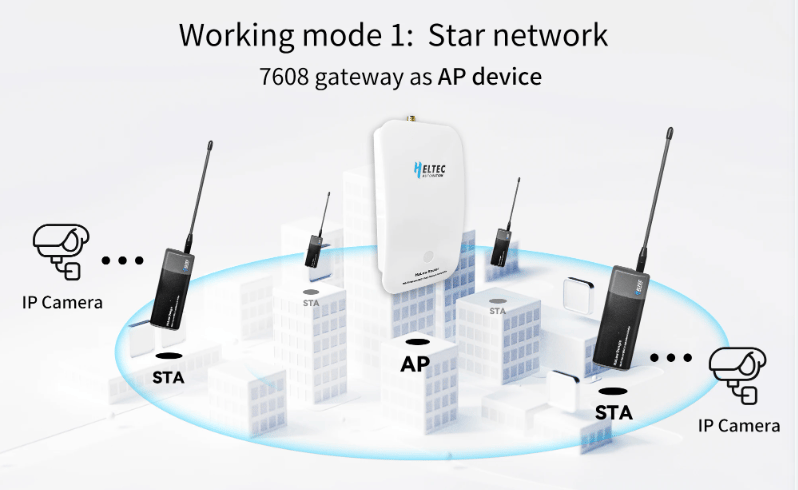
China-based Heltec Automation now produce their own Morse Micro-powered Wi-Fi HaLow modules, cameras, and router/gateway/dongle combinations. The latter can be used either for point-to-point communications (with 1 kilometre of range) or in star network topology with the gateway configured as an AP device. The Morse Micro & Heltec Automation partnership was announced in June.
Above: Heltec Automations’ HaLow AP (gateway) & ‘dongle’ combination in start network mode.
AsiaRF expands Wi-Fi HaLow product portfolio
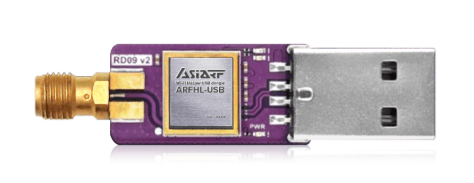
Finally: If you’re looking for low-cost and highly adaptable Wi-Fi HaLow equipment then AsiaRF is a front runner among vendors of HaLow APs and client devices. AsiaFR will release a new Wi-Fi HaLow dongle in September. Meanwhile the company at this time probably offers the largest selection of HaLow equipment of any vendor – have a look here.
This website uses cookies to improve your experience. Read more in our privacy statement. Accept
Privacy & Cookies Policy
Privacy Overview
This website uses cookies to improve your experience while you navigate through the website. Out of these, the cookies that are categorized as necessary are stored on your browser as they are essential for the working of basic functionalities of the website. We also use third-party cookies that help us analyze and understand how you use this website. These cookies will be stored in your browser only with your consent. You also have the option to opt-out of these cookies. But opting out of some of these cookies may affect your browsing experience.
Necessary cookies are absolutely essential for the website to function properly. This category only includes cookies that ensures basic functionalities and security features of the website. These cookies do not store any personal information.
Any cookies that may not be particularly necessary for the website to function and is used specifically to collect user personal data via analytics, ads, other embedded contents are termed as non-necessary cookies. It is mandatory to procure user consent prior to running these cookies on your website.