

By Claus Hetting, WiFi NOW CEO & Chairman
Introduction
Europe is approaching one of the most consequential wireless policy decisions of the decade. The debate surrounding the upper half of the 6 GHz band (6425–7125 MHz) is no longer simply about spectrum allocation. It is about how Europe intends to build the digital infrastructure required for artificial intelligence, advanced enterprise networking, industrial automation, healthcare innovation, and next-generation wireless connectivity. The debate is really about Europe’s connected digital future.
While many countries around the world have already opened the full 6 GHz band for Wi-Fi, Europe has so far taken a far more cautious approach. The UK regulator Ofcom has now proposed a novel framework designed to allow immediate Wi-Fi use while preserving future options for mobile services. Meanwhile, the European Union’s Radio Spectrum Policy Group (RSPG) has recommended delaying major decisions on the upper 6 GHz band pending the outcome of the 2027 World Radiocommunication Conference (WRC-27).
This Resource Centre report draws on presentations from Ofcom, the Wi-Fi Alliance and Cisco presented during a recent WiFi NOW webinar to explain the competing regulatory approaches, the technologies involved, and what is ultimately at stake for Europe’s digital future.
Why 6 GHz matters
For more than twenty years, Wi-Fi performance has improved largely by gaining access to additional spectrum. The 6 GHz band represents the largest expansion of Wi-Fi spectrum since the technology was introduced. Together, the lower and upper portions of the band provide up to 1,200 MHz of contiguous spectrum—enough to support multiple wide 160 MHz and 320 MHz channels required by Wi-Fi 7 and future Wi-Fi generations.
These wide channels are not simply about achieving higher peak data rates. They also provide
- Lower latency
- Reduced congestion
- Higher reliability
- Deterministic performance
- Capacity for large numbers of simultaneous users
These characteristics increasingly matter as Wi-Fi evolves beyond Internet access into the primary connectivity platform for enterprise networks, industrial automation, immersive applications, and AI-enabled systems.
Europe’s regulatory crossroads
Today, Europe permits licence-exempt Wi-Fi operation only in the lower 500 MHz of the 6 GHz band (5925–6425 MHz). The future of the remaining 700 MHz remains undecided. Two fundamentally different regulatory philosophies have emerged.
Ofcom’s (UK regulatory body) proposal
Ofcom proposes a phased sharing model that would:
- Permit an additional 160 MHz of low-power indoor Wi-Fi
- Allow standard-power indoor and outdoor Wi-Fi across the full upper 6 GHz band under Automated Frequency Coordination (AFC)
- Preserve future mobile access where and when required
- Dynamically coordinate spectrum sharing rather than permanently reserving spectrum.
Who is Ofcom? Office of Communications (Ofcom) is the United Kingdom’s communications regulator, responsible for managing radio spectrum and regulating telecommunications, broadcasting, and wireless services across the UK.
The RSPG (Europe’s consultative regulatory body) recommendation
The current RSPG opinion recommends:
- Reserving most of the upper 6 GHz band pending WRC-27
- Considering only the lowest 160 MHz after WRC-27 depending on international outcomes
- Continuing to prioritise potential future IMT (5G/6G) use for the remaining spectrum.
The practical consequence is that Europe could delay broader Wi-Fi access to upper 6 GHz until well into the second half of this decade.
Who is RSPG? Radio Spectrum Policy Group (RSPG) is the European Commission’s independent advisory group on radio spectrum policy. It brings together representatives from EU Member States to provide strategic recommendations on how radio spectrum should be managed across Europe. RSPG’s recommendations are not binding but consultative.
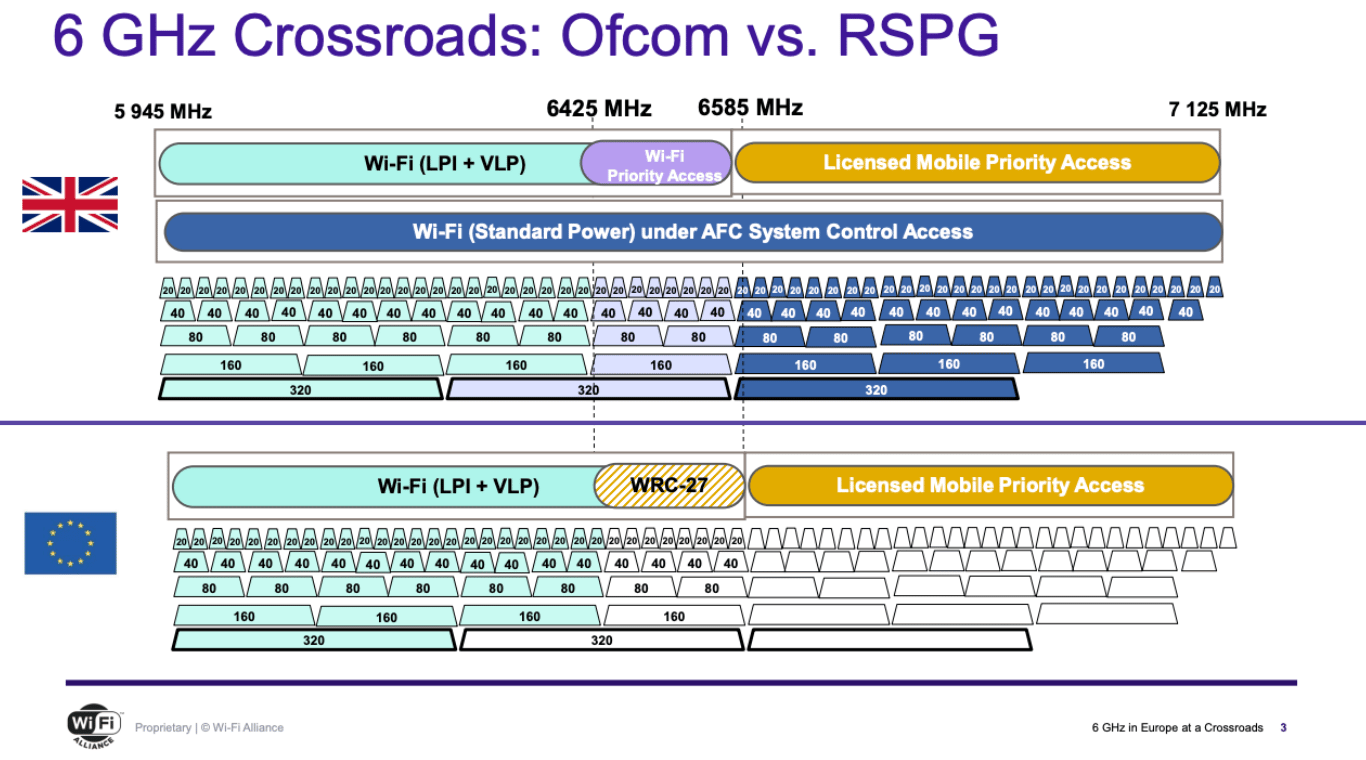
Ofcom’s proposal: sharing instead of waiting
One of the webinar’s most significant contributions was Ofcom’s explanation of its proposed regulatory model. Rather than viewing spectrum allocation as a permanent decision, Ofcom proposes using Automated Frequency Coordination (AFC) to manage access dynamically (also read more about AFC in our technology guide here).
In simple terms, AFC works as a cloud-based spectrum management system. Standard-power Wi-Fi access points periodically query an authorised database that calculates which frequencies and transmit power levels may safely be used at a particular location while protecting incumbent licensed users. The concept is already operating successfully in the United States and Canada to protect fixed microwave links.
Ofcom proposes extending the same principle to support future coexistence with mobile services. According to Ofcom, this approach allows the UK to unlock the value of the spectrum immediately while maintaining flexibility should future mobile demand materialise.
As Siew Yoon Tan explained during the webinar: “This is not Wi-Fi versus mobile. It is about how we maximise the value of spectrum over time while adapting as technology and market needs evolve.”
Why timing matters
A recurring theme throughout the webinar was timing. Wi-Fi equipment supporting 6 GHz already exists and is shipping in volume. Potential 6G systems using upper 6 GHz remain several years away. Ofcom argues that leaving valuable spectrum unused throughout this period represents a missed opportunity for consumers, enterprises and the wider economy.Its proposal therefore seeks to capture immediate value while retaining the ability to adapt later if demand changes. The philosophy represents a shift away from static spectrum allocation towards more dynamic spectrum management.
Why Wi-Fi needs upper 6 GHz
Alex Roytblat of the Wi-Fi Alliance argued that Wi-Fi 7 was designed around access to the full 6 GHz ecosystem. Without sufficient contiguous spectrum, many of the technology’s most important capabilities become difficult—or impossible—to realise in practice. Modern Wi-Fi environments contain dozens of simultaneously active devices, all competing for airtime.
Wide 160 MHz and 320 MHz channels provide the capacity needed for:
- AI-assisted applications
- Immersive AR/VR
- Cloud computing
- Industrial automation
- Ultra-high-definition video
- Next-generation collaboration platforms
Alex Roytblat argued that restricting access to upper 6 GHz effectively limits the performance benefits that Wi-Fi 7 was designed to deliver.
Fibre only reaches the building
One of the strongest economic arguments presented during the webinar concerned Europe’s investment in fibre infrastructure. Europe is spending billions expanding gigabit broadband. However, fibre typically terminates at the building wall – and eend users connect via Wi-Fi.
According to the Wi-Fi Alliance, approximately 90% of broadband traffic ultimately reaches users over Wi-Fi rather than Ethernet. If Wi-Fi lacks sufficient spectrum, gigabit fibre cannot consistently deliver gigabit performance to end devices. In effect, fibre-to-the-home risks becoming fibre-to-the-wall.
Enterprise Wi-Fi has changed
Cisco’s Pelin Salem argued that the discussion extends well beyond faster internet access. Today’s enterprise environments have become increasingly wireless-first.
Modern Wi-Fi networks support:
- AI edge computing
- Robotics
- Industrial automation
- Building management
- IoT sensors
- Security systems
- Augmented and virtual reality
- Healthcare
- Logistics
- Large public venues.
As enterprises adopt more mission-critical wireless applications, network requirements increasingly focus on predictable latency, reliability and scalability rather than peak throughput alone.
Healthcare provides a compelling example
Cisco highlighted a Wi-Fi Alliance trial conducted at Thailand’s Ramathibodi Hospital. The trial demonstrated advanced AR/VR surgical training using the full 1,200 MHz available in the 6 GHz band. Compared with narrower spectrum allocations, the full band delivered more stable throughput and lower latency, enabling real-time remote instruction and immersive medical education. The example illustrates how spectrum policy can directly influence practical applications in healthcare rather than simply affecting broadband speeds.
Enterprise deployments extend outdoors
Another important point raised during the webinar is that enterprise Wi-Fi increasingly extends beyond office buildings. Examples include:
- University campuses
- Logistics centres
- Industrial sites
- Hospitality
- Stadiums
- Transport hubs
- Construction sites
- Resorts
These environments often require outdoor Wi-Fi operating at higher power levels. Cisco argued that standard-power Wi-Fi operating under AFC provides a practical way of enabling these deployments while protecting incumbent spectrum users.
AFC moves coexistence from theory to practice
Cisco described AFC not simply as a regulatory mechanism but as an engineering solution. Instead of permanently excluding Wi-Fi from particular frequencies, AFC continuously determines which channels and power levels are safe at a given location.
This transforms coexistence from static spectrum segregation into dynamic spectrum coordination. Rather than viewing Wi-Fi and licensed users as competing interests, the system attempts to maximise spectrum utilisation while protecting incumbent services.
Levi’s Stadium demonstrates the concept
Cisco also highlighted Levi’s Stadium in California as an operational example of AFC-enabled Wi-Fi 7 deployment. The stadium combines:
- Wi-Fi 7
- 6 GHz
- AFC
- Standard-power operation
- Hyper-directional access points
– to support:
- Media operations
- Security
- Point-of-sale
- Staff communications
- High-density fan connectivity.
The deployment illustrates that AFC is no longer simply a theoretical regulatory concept but an operational technology supporting one of the world’s most demanding wireless environments.
What if Europe waits?
The webinar repeatedly returned to one central question. What happens if Europe postpones upper 6 GHz access while the rest of the world continues deploying Wi-Fi across the full band? The speakers identified several potential consequences:
- Slower enterprise innovation
- Reduced competitiveness
- Fragmented device ecosystems
- Delayed AI deployment
- Higher networking costs
- Reduced return on fibre investment
- Increased indoor congestion
- Slower adoption of advanced wireless applications.
Supporters of the RSPG approach would argue that preserving spectrum protects future strategic flexibility for mobile services. Supporters of Ofcom’s proposal contend that dynamic sharing can achieve both objectives simultaneously. The debate therefore centres not on whether mobile services matter—they clearly do—but on whether reserving unused spectrum today is preferable to sharing it dynamically until future demand genuinely materialises.
What happens next?
Ofcom expects to reach a final decision on its proposal before the end of 2026. Within the European Union, broader decisions are likely to depend on the outcome of WRC-27 and subsequent policy discussions. Consequently, Europe and the UK may soon follow different regulatory paths for upper 6 GHz, at least temporarily.
WiFi NOW Perspective
The debate surrounding Europe’s upper 6 GHz band is often portrayed as a straightforward contest between Wi-Fi and future mobile services. The discussions during this webinar suggest that the real issue is more nuanced. All parties agree that both Wi-Fi and mobile connectivity are essential components of Europe’s digital infrastructure. The fundamental question is not which technology should prevail, but how regulators can maximise the value of spectrum throughout its lifetime.
Ofcom’s proposal is noteworthy because it shifts the discussion away from permanent allocation towards dynamic coexistence. By using Automated Frequency Coordination to manage access in real time, the proposal attempts to balance immediate innovation with long-term flexibility. Whether this approach ultimately becomes a model for Europe remains to be seen.
What is already clear, however, is that decisions on upper 6 GHz will influence far more than Wi-Fi performance. They will shape enterprise networking, AI deployment, healthcare innovation, industrial automation and the overall competitiveness of Europe’s digital economy for many years to come.
Standard Resource Centre disclaimer
Editorial note: This report is based on presentations delivered by Ofcom, the Wi-Fi Alliance and Cisco during a WiFi NOW webinar, together with publicly available regulatory documents. The analysis and WiFi NOW Perspective represent WiFi NOW’s editorial assessment. Regulatory proposals remain subject to consultation and change.