By Claus Hetting, WiFi NOW CEO & Chairman
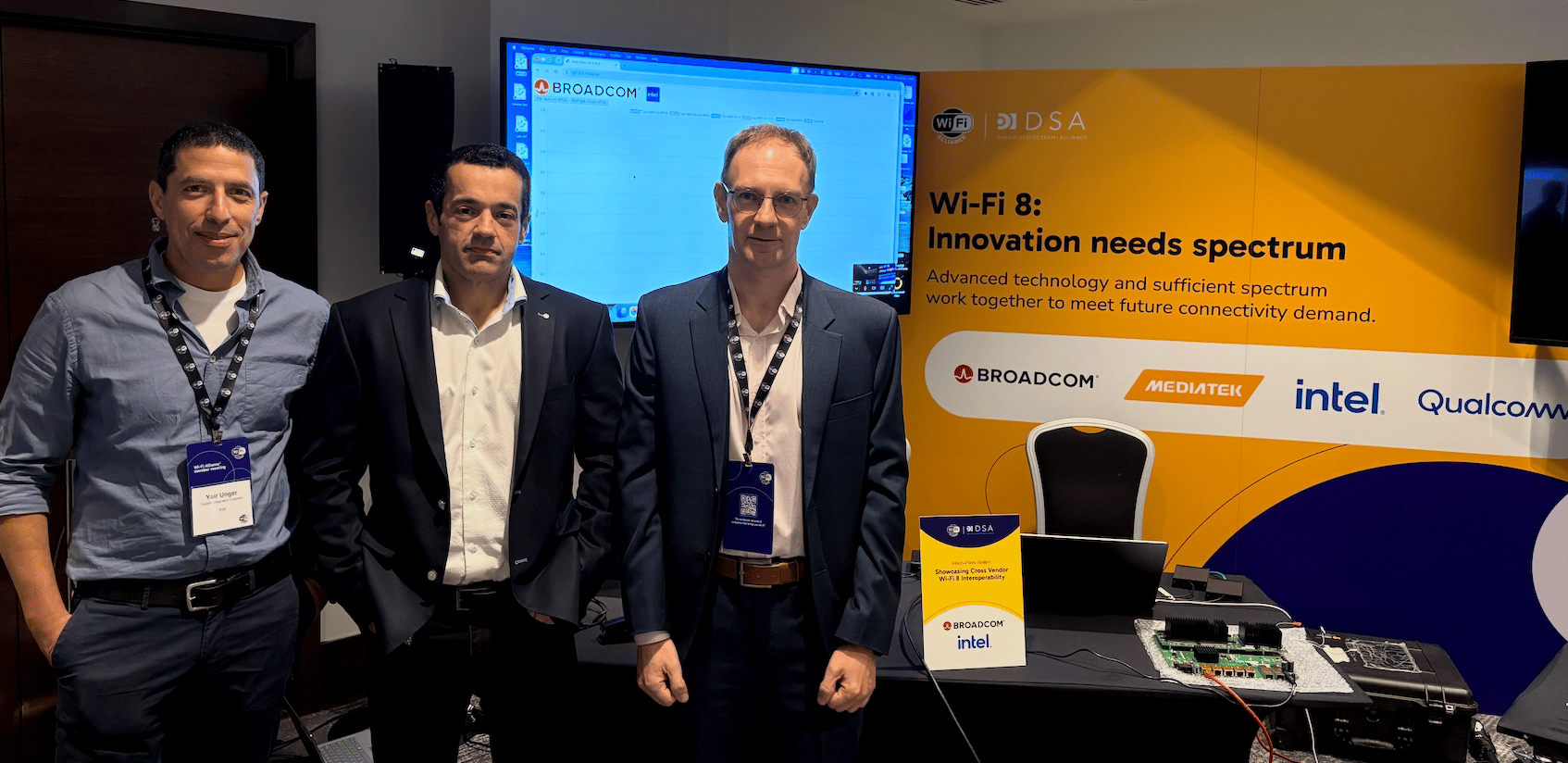
Last week Intel and Broadcom conducted the first public interoperability demonstration between Wi-Fi 8 devices from the two companies. The demonstration showed approximately 30% higher aggregate throughput and up to 50% lower latency using the Non-Primary Channel Access (NPCA) feature and existing spectrum resources. The demonstration was held at Wi-Fi Alliance’s most recent members meeting in London, U.K., which was colocated with the Dynamic Spectrum Alliance Global Summit.
One of the most important promises of Wi-Fi 8 is that wireless networks will become significantly more efficient – not necessarily because they have access to more spectrum, but because they will make much better use of the spectrum already available.
That was the central message of a recent live Wi-Fi 8 demonstration conducted jointly by Intel and Broadcom for an audience of wireless regulators. The demonstration was held at the joint Wi-Fi Alliance members meeting and Dynamic Spectrum Alliance Global Summit in London, U.K. last week and featured a Broadcom-based Wi-Fi 8 access point interoperating with an Intel Wi-Fi 8 client – alongside existing Wi-Fi 7 equipment for comparison.
The results were impressive: Approximately 30% higher aggregate throughput and up to 50% lower latency compared to operation without the new Wi-Fi 8 feature enabled. The demonstration also represented an important milestone for the Wi-Fi industry: The first public interoperability demonstration between Wi-Fi 8 devices from the two companies, according to Intel.
Making better use of existing spectrum
Intel Fellow and Wireless CTO Carlos Cordeiro said the purpose of the demonstration was to show regulators how Wi-Fi 8 technology can extract more performance from existing spectrum allocations, and to demonstrate that the industry’s next generation of Wi-Fi devices is already progressing towards interoperability. The key technology demonstrated was Non-Primary Channel Access, or NPCA, which addresses one of the longstanding inefficiencies of Wi-Fi networks operating in congested environments.
“Consider a typical deployment with multiple access points sharing the same 160 MHz channel. Under existing operating conditions, one access point may gain access to the channel while another must wait – even when the first transmission only occupies part of the available channel bandwidth. For example, an access point may support 160 MHz channels, while its associated client supports only 80 MHz. This means that part of the available spectrum can remain unused during a transmission, even though another network could potentially make use of it,” Carlos Cordeiro says.
NPCA changes this by allowing a Wi-Fi 8 device to access an available non-primary portion of the channel while another network is transmitting elsewhere within the wider channel. In other words, instead of forcing networks to take turns unnecessarily, Wi-Fi 8 allows more efficient use of the available spectrum, he said. The theoretical improvement can be substantial, although actual performance depends on network conditions, client capabilities, signal quality, and other factors.
30% higher throughput and up to 50% lower latency
To illustrate the benefits, Intel and Broadcom constructed a live demonstration using actual access points, laptops, and Wi-Fi client devices. The setup first demonstrated the performance of a Wi-Fi 7 network operating without additional interference. A second access point was then activated on the same channel, causing throughput to drop as the two networks competed for access to the spectrum. The demonstration then showed the difference when Wi-Fi 8’s NPCA feature was enabled.
According to Intel, the result was approximately 30% higher aggregate throughput and up to 50% lower latency compared to the baseline scenario in which the access points were effectively taking turns accessing the channel. These are significant improvements, particularly because they are achieved without requiring additional spectrum.
“The results also illustrate an important shift in the direction of Wi-Fi innovation: While previous generations have focused heavily on increasing peak data rates, Wi-Fi 8 is increasingly about improving the performance, reliability, and efficiency of networks under real-world operating conditions. For enterprise networks, densely populated residential environments, and other deployments with overlapping access points, the potential benefits are considerable,” Carlos Cordeiro said.
Intermediate modulation rates offer further efficiency gains
NPCA was not the only Wi-Fi 8 innovation included in the demonstration setup. Intel also prepared a demonstration of new intermediate Modulation and Coding Scheme (MCS) levels, although this demonstration was not presented live during the main event because of time constraints.
“The principle is relatively straightforward: Wi-Fi devices continuously adjust their transmission rates according to prevailing radio conditions. When signal quality improves, devices can move to higher modulation and coding rates. When conditions deteriorate, they move to lower rates to maintain reliable communication. In previous Wi-Fi generations, some of the steps between available MCS levels have been relatively large. This means that a device may have to select a lower transmission rate than the radio conditions could otherwise support,” Carlos Cordeiro said.
Wi-Fi 8 introduces additional intermediate MCS levels, allowing devices to make smaller adjustments and potentially extract more performance from a given radio link. Once again, the objective is improved spectrum efficiency rather than simply increasing the theoretical maximum data rate.
A message to regulators: Wi-Fi is using spectrum more efficiently
With regulators around the world continuing to consider how spectrum should be allocated between competing wireless technologies, the Wi-Fi industry is keen to demonstrate that it is making increasingly efficient use of its existing spectrum resources. Intel’s message was that Wi-Fi 8 can deliver meaningful improvements in throughput and latency even without access to additional spectrum.
At the same time, the industry continues to make the case that additional spectrum would enable still greater improvements in wireless capacity and performance. The live demonstration reportedly attracted considerable interest from attendees, including requests to repeat the tests after the formal event had concluded. For Intel and Broadcom, the demonstration also served another purpose: Showing that Wi-Fi 8 interoperability is progressing beyond individual chipset development and into practical, working implementations.
Intel Wi-Fi 8 products still some way from commercial launch
Although the demonstration used functioning Wi-Fi 8 silicon and devices, Intel’s next-generation Wi-Fi 8 client products are not yet commercially available. Intel says it intends to complete the industry’s interoperability testing process before launching its Wi-Fi 8 products. According to the interview, a final planned so-called ‘plugfest’ is expected around 3Q2027.
This suggests that Intel’s commercial Wi-Fi 8 client introduction will follow further interoperability validation, although no specific launch date was confirmed. Meanwhile, the first public interoperability demonstration between Intel and Broadcom provides another indication that the Wi-Fi 8 ecosystem is beginning to take shape.
Perhaps the most important takeaway – however – is not simply that Wi-Fi 8 equipment is already working. It is that the next generation of Wi-Fi is beginning to demonstrate measurable improvements in how efficiently wireless networks use spectrum – with significant potential benefits for performance and latency in increasingly congested environments. And that may ultimately prove to be one of Wi-Fi 8’s most valuable contributions to the wireless industry.
/Claus.