
By Claus Hetting, WiFi NOW CEO & Chairman
As broadband service providers continue to look for better ways to improve the customer’s quality of experience, much of the industry has turned towards Cloud-based platforms for analytics, diagnostics, and optimisation. Netduma is taking a different approach: The Cambridge-based company says real-time management and optimisation of the customer’s home broadband and Wi-Fi experience should take place directly on the CPE.
The UK-based software company has developed an on-device platform designed to actively improve application performance in real time as traffic is flowing. Netduma’s technology detects and controls congestion, allocates bandwidth based on application requirements, and programs Wi-Fi scheduling mechanisms to match what applications and devices actually need. The objective is to optimise the experience across the connectivity path – from the broadband connection into the home to the Wi-Fi links serving individual devices, the company says.
The ‘crown jewel’: Access to the hardware fast path
At the heart of Netduma’s approach is a capability the company calls its crown jewel: Operating inside the hardware-accelerated forwarding path of broadband gateways. Modern gateways typically move established traffic away from the conventional Linux networking stack and into hardware acceleration. On some platforms, Linux may see only the first few packets before acceleration takes over, Netduma says.

“This is a basic and nearly unsolvable problem for optimisation software: Losing visibility into the millions of subsequent packets making up a video stream, video conference, game, or other application session. We’ve solved this by integrating our technology directly into the hardware fast path, allowing our software to continue measuring and acting on traffic throughout a session,” says Netduma Co-founder & CTO, Iain Fraser.
Three layers of real-time QoE optimisation
Netduma’s Optimization suite combines three core technologies: The first is patented Adaptive Congestion Control, or ACC. Netduma says ACC can detect queue build-up before latency increases significantly and – importantly – the system controls bottlenecks without its software being installed at the bottlenecks themselves. “This means the gateway can address congestion in the broadband access connection as well as downstream and upstream Wi-Fi bottlenecks,” Iain Fraser says.
The second component is application-aware bandwidth allocation. Rather than simply assigning traffic to broad priority categories, Netduma allocates resources according to what applications actually require. A video conference, buffered video stream, and online game have very different requirements for bandwidth, latency, jitter, and packet loss. “We maintain an application requirements database based on published specifications and our own testing. The objective is to combine knowledge of the application with an understanding of where congestion is occurring and intervene accordingly,” he says.
The third component is Wi-Fi quality of service scheduling. Netduma interfaces directly with Wi-Fi chipsets and driver functionality to manage features including OFDMA, MU-MIMO, and Multi-Link Operation. The company has worked with mechanisms including Broadcom’s Low Latency API and Qualcomm’s Service-Aware Queue. “Supporting advanced Wi-Fi features does not automatically improve application experience. The Wi-Fi system needs to know what individual applications require. Application awareness can therefore be used to program the underlying Wi-Fi capabilities with the appropriate intent,” Iain Fraser says.
Application intelligence drives the optimisation
Supporting all three optimisation layers is Netduma’s traffic classification technology. The company combines Deep Packet Inspection with Behavioural Identification and says it can classify thousands of applications locally on the CPE. Its signature database can be updated from the Cloud every four hours, but customer traffic does not need to be sent to the Cloud for classification.
Behavioural Identification also allows Netduma to recognise some encrypted traffic from its characteristics without decrypting the contents. Once an application has been identified, its requirements can feed directly into congestion control, bandwidth allocation, and Wi-Fi scheduling. Traffic identification – in other words – is not the end product but rather an input to real-time QoE optimisation.
Measuring what customers actually experience
The same on-device architecture is also the foundation for Netduma’s Insights suite. Netduma says it can passively measure actual customer traffic through the hardware fast path, collecting thousands of samples per second across latency, jitter, packet loss, throughput, and more than 70 other signals. QoE scoring can then trigger deeper diagnostics when the customer experience deteriorates rather than continuously generating large volumes of diagnostic data.
“The cloud still plays an important role, but we’re using it differently. Measurement data can be compressed and stored locally, with richer information reported when a genuine QoE problem occurs. Operators can analyse the resulting data themselves or use our Insights platform. An AI Assistant provides a natural-language interface to this information, allowing an operator to ask questions such as why a customer’s Netflix experience is poor and receive a diagnosis based on the underlying measurements. The platform currently identifies around 50 categories of root causes,” Iain Fraser says.
Managing the experience – not just the network
Ultimately, Netduma’s proposition challenges the traditional focus on broadband speeds and Wi-Fi specifications. “Customers don’t experience a PHY rate or a speed-test result. They experience Netflix, Teams, Zoom, gaming, and other applications – and a problem can originate in the broadband connection, congestion elsewhere in the path, the home Wi-Fi network, or competition between applications and devices. Our technology is designed to address that reality,” he says.
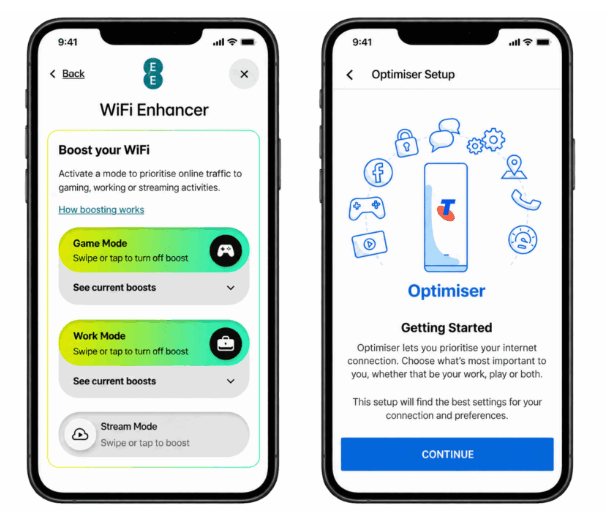
Netduma’s technology is currently deployed in more than 10 million homes and clients include Tier 1 operators such as BT/EE and Telstra. Also see our Tech Watch interview with Netduma Co-founder & CEO, Luke Barlow here.
/Claus.