By Claus Hetting, WiFi NOW CEO & Chairman
After nearly fifteen years and more than 100 stadium projects, AmpThink is once again pioneering new stadium Wi-Fi technology: This time it is all about transitioning to hyper-directional antenna technology, AmpThink says. Meanwhile the company continues to deploy stadium Wi-Fi networks while developing and manufacturing the specialised enclosures and installation kits that make extreme high-density stadium Wi-Fi possible.
Making ultra-high-density stadium Wi-Fi work as intended (or even just work reasonably well) is probably the most challenging of all wireless networking disciplines: Thousands of fans – today equipped with gigabit-capable devices – packed together within a small area is normally the recipe for a connectivity disaster. But AmpThink and its vendor partners have over the years resolved a raft of tricky problems to the point where stadium Wi-Fi on a grand scale – for example for NFL or university stadiums in the US – has become nothing short of spectacularly successful. This was not always the case, AmpThink says.
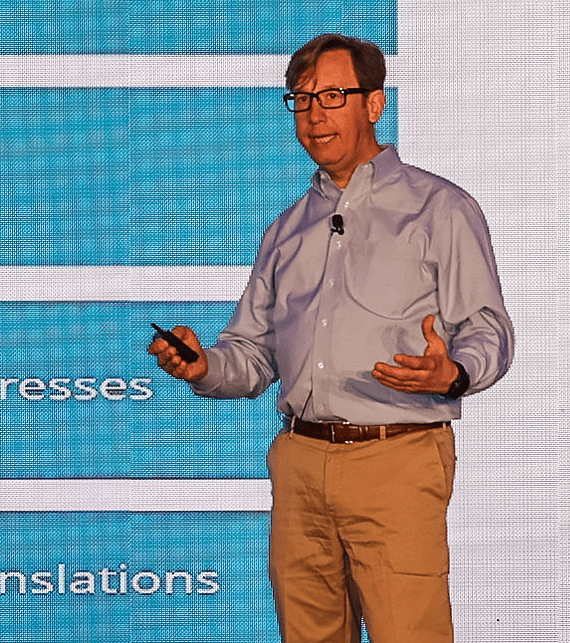
“Today’s high-quality stadium Wi-Fi is well established but the road to making it all work has been fraught with challenges. The truth is that when we started in 2011, nobody had any deep experience deploying stadium Wi-Fi. Lucas Oil Stadium in Indianapolis became our first extreme high-density stadium Wi-Fi project together with Cisco. After dozens of successful stadium Wi-Fi projects, we’re now transitioning to a new paradigm that we’re calling hyper-directional networking. This means that specialised and highly directional APs will be installed high overhead, with more than 200 feet of distance between the client and the antenna. It’s a revolution in stadium Wi-Fi on multiple levels,” says Bill Anderson, founder and CEO of AmpThink.
The new approach is a radical departure from what has been the norm for more than a decade. For most of the history of stadium Wi-Fi, the strategy has been to position hundreds or even thousands of APs as close to the fans as possible, which means installing APs under stadium seats as well as suspended from handrails. AmpThink was the first to introduce custom under-seat enclosures in 2012, Bill Anderson says.
“It sounds simple, but Wi-Fi APs are not designed to be installed under seats in a stadium, for example. We had to design and manufacture the right enclosures by the tens of thousands to support our own stadium Wi-Fi deployment projects. This has become the basis of our enclosures product line today. We know that they work reliably because our own stadium Wi-Fi projects depend on them,” he says.
While proximity networking – meaning positioning APs close to users – continues to work well in stadiums and is still widely used even for new installations, it is also notoriously costly. Bill Anderson says under-seat installation costs are high but hidden operational costs are even more significant and can run into the millions of dollars. Transitioning to overhead APs has always been enticing but brought with it the need to invent highly directional AP and antenna systems. AmpThink initially worked with Everest Networks and since Cisco to push for the introduction of new Wi-Fi radio technology, Bill Anderson says.
“The future of stadium Wi-Fi is without a doubt hyper-directional. This is becoming essential to all our network designs. Cisco’s Catalyst 9104 is precisely made for this purpose because it delivers the right directional characteristics and is software-configurable. A big part of the technical ‘trick’ here is to deliver highly directional beams while filtering away the inevitable side lobes in the radiation pattern. Cisco’s done an exceptional job in developing this product,” he says.
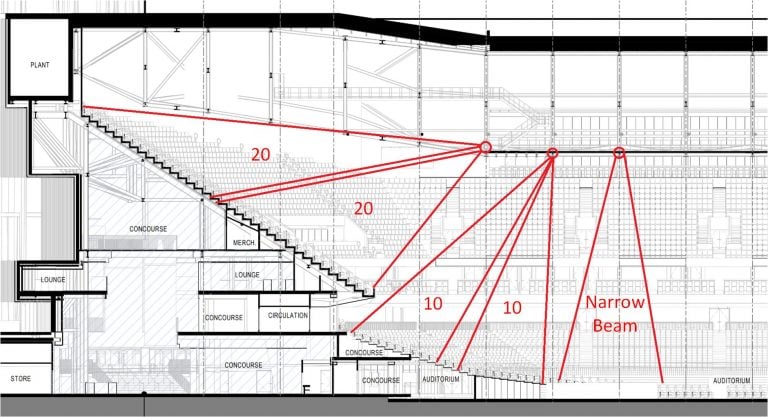
Overhead APs – which in practice means fewer APs but more radios installed within the stadium – are more cost-effective and the result is simplified and hence less costly operations. AmpThink has designed (and is today manufacturing) the specialised turnable and tiltable mounting kits for installing overhead stadium APs (such as Cisco’s CW9179F) along stadium catwalk structures. Fixing the APs securely to stadium structures is important but even more important is pointing the built-in antenna arrays accurately to the right seat sections (see figure above) to ensure non-overlapping, reliable Wi-Fi coverage.
Meanwhile building or upgrading stadiums and stadium technology including Wi-Fi networks is a growing business in the USA with US as joint host of next year’s FIFA World Cup and Los Angeles due to host the 2028 Olympic Games. AmpThink is involved in many of the projects including at the SoFi stadium in Los Angeles. At the moment multiple new stadium projects are underway, AmpThink says.
For more about AmpThink stadium Wi-Fi enclosures and installation kits, click here. For more about Cisco’s Catalyst 9104 also read here.
/Claus.