By Claus Hetting, WiFi NOW CEO & Chairman
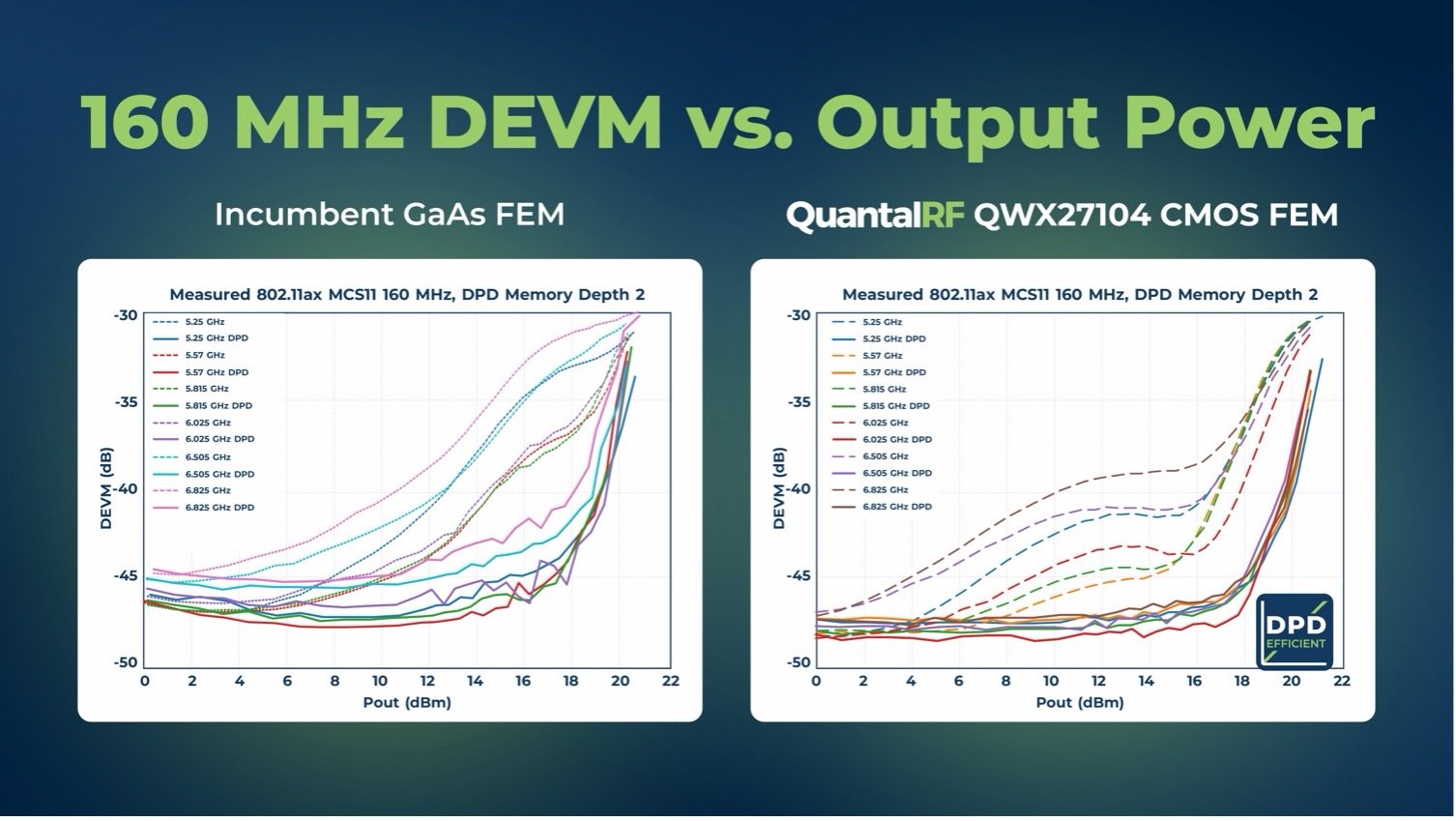
QuantalRF’s ultra-linear analog-only FEM technology is being developed for use in Wi-Fi products – but for the many cases where the industry still prefers using digital pre-distortion (DPD), QuantalRF has a solution for that, too. This week the company launched a new ‘DPD-efficient FEM’ delivering up to 3 dB more power at wide channel bandwidths, which is exactly where Wi-Fi 7 and Wi-Fi 8 need the performance most, QuantalRF says.
Conventional Wi-Fi front-end modules (FEMs) use GaAs amplifiers coupled with heavy digital pre-distortion to achieve approximate linearised power outputs. But what if you could get better power performance and linearity from your FEM with only a light digital correction? QuantalRF says its new Elementum™ QWX27104 FEM – designed for both Wi-Fi 7 and Wi-Fi 8 – does exactly that.
The new FEM takes advantage of QuantalRF’s inherently ultra-linear CMOS RF-SOI architecture leaving less work to be done by the DPD. The performance results speak for themselves, says Dave Aichele, EVP Sales & Business Development at QuantalRF.
“Because linearity is engineered into the FEM itself, our new device achieves its target error vector magnitude (EVM) with a lower-order, less complex DPD engine. That efficiency translates directly into up to 3 dB more mask-compliant output power under the most demanding modulations, greater tolerance to system, temperature and process variations, and a lighter, simpler DPD burden on the host SoC,” he says.

QuantalRF says it has started sampling the new device to Tier-1 mobile OEMs and SoC makers. The device is particularly important when it comes to amplifying the complex, wideband modulations that define Wi-Fi 7 and Wi-Fi 8, QuantalRF says. “Traditional GaAs amplifiers using DPD consume computational resources, increase power consumption, and erode design margin, while becoming progressively more difficult to sustain as channel bandwidths widen to 160 and 320 MHz. We’re doing away with many of these limitations with our DPD-efficient Linear FEM,” Dave Aichele says.
A significant benefit is the device’s consistent performance across the entire band. “With DPD applied at 160 MHz bandwidth, the QWX27104 DPD-Efficient Linear FEM maintains EVM within 0.5 dB across all channels, while competitive GaAs solutions can vary by more than 4 dB from channel to channel. Such variations force designers to reduce output power to guarantee worst-case compliance. The result is more real, deployable output power at wide bandwidths and dense constellations that define next-generation Wi-Fi,” he says.
QuantalRF says it has spent five years developing its intelligent and adaptive architecture with a multi-loop analog intelligent feedback system allowing the FEM to self-optimise in real time. The architecture boosts efficiency and linearity across all modes and channel conditions. For more on state-of-the-art FEM and RF filter technology, explore how QuantalRF’s approach compares to conventional linearisation with DPD in our WiFi NOW Resource Centre here.
Built on GlobalFoundry’s commercial 8SW RF-SOI process, the QWX27104 Linear FEM integrates the PA, LNA, switch, and coupler onto a single monolithic die. The QWX27104 joins QuantalRF’s fully linear QWX27105 FEM in the Elementum™ portfolio, extending the company’s CMOS RF-SOI front-end family across a broader range of system architectures.
Don’t miss QuantalRF speaking at the Wi-Fi World Congress Europe Online Edition on October 8 – go here to view and register.
/Claus.