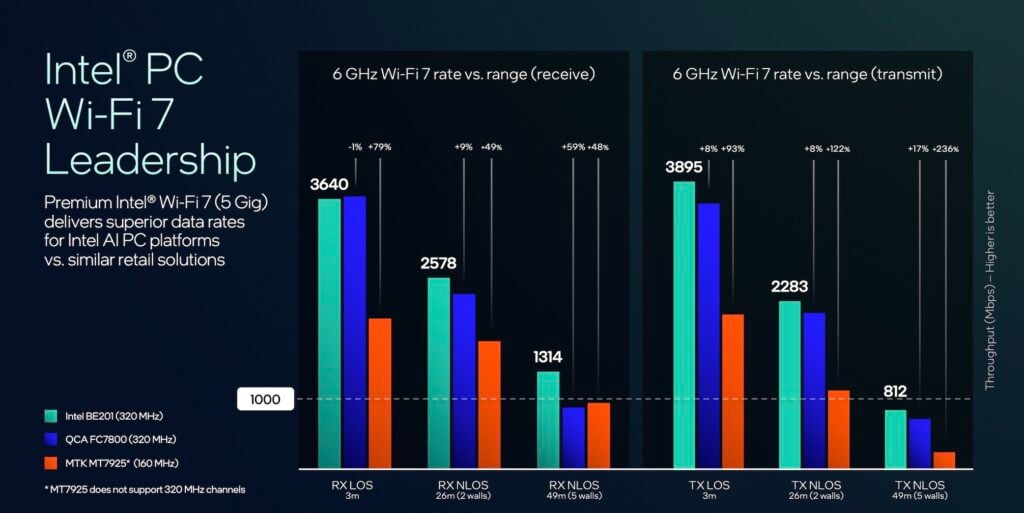
Intel is well known for delivering state-of- the-art connectivity for laptops – and now the company is once again leaping ahead: Intel’s latest feature pack – part of the Intel Core Ultra (Series 3) computing platform released this week – introduces plenty of innovations to boost the connected laptop experience. Intel also released a set of new test results illustrating how its current Wi-Fi 7 implementation delivers industry-leading throughput performance as a function of range (see graphic above).
Intel’s Wi-Fi 7 connectivity platform for laptops is already delivering multi-gigabit performance and now the company is adding significant new Wi-Fi 7 Release 2 (R2) features as well as other new functionality aimed at enhancing the overall wireless connectivity experience. Wi-Fi 7 R2 features are focused on delivering improved network performance, reliability, and efficiency, Intel says.
New Wi-Fi 7 R2 functionality includes support for multi-link reconfiguration allowing dynamic adjustment of multi-link (MLO) setups on the fly and across bands without having to create or tear down new associations. Intel says the feature is a significant step up in MLO performance by – for example – allowing seamless failover to less congested channels, which leads to improved latency and throughput.
Other features include restricted TWT (restricted Targeted Wait Time) for increased reliability and single digit millisecond latency by allowing only authorised stations to transmit during the service period. Perhaps more important for the average laptop user is Intel’s introduction of Single-Link eMLSR (also part of the MLO framework in Wi-Fi 7 R2): This feature allows laptops equipped with dual antennas to reserve one antenna for MLO while the other is used for idle power savings or other wireless activities. Dual-antenna Wi-Fi designs are typically needed to maintain simultaneous links across both antennas for dynamic connection optimization, Intel says.
Finally, the new platform allows P2P channel configuration, guiding peer-to-peer Wi-Fi connectivity to non-interfering Wi-Fi channels. This boosts performance for example for single-radio AR/VR devices and wearables, Intel says.
More software features for optimisation
But that is far from everything. Intel is also introducing improvements to the Intel Connectivity Performance Suite (ICPS), which for a number of years has been Intel’s unique Wi-Fi optimisation software value-add designed to boost connectivity QoE by prioritising traffic at the application level. The software suite even optimises AP selection by switching to the highest performing AP (read more here). ICPS is today an integral part of Intel’s Evo (high-end consumer) and vPro (business) laptop platforms.
The new ICPS release boasts application-level Wi-Fi traffic prioritisation in both UL and DL directions, includes advanced Bluetooth monitoring, and perhaps most notably introduces AI-aware QoS. Intel says AI-Aware QoS delivers up to 30% more responsive AI-based PC experiences by prioritising AI data over other PC client data. The new feature – controllable via the ICPS dashboard – should be a boon for heavy ChatGPT users.
In general it is no mystery that Intel does exceedingly well when it comes to connectivity performance. If you’ve ever had the privilege of visiting Intel’s Wi-Fi test lab in the vicinity of Hillsboro, Oregon (I’m grateful to say that I have) you will know that Intel goes to tremendous lengths to test, analyse, and verify Wi-Fi platform RF designs and performance (including interoperability) against practically all significant AP providers. One of the results of Intel’s extended research and development process is performance excellence also when it comes to non-line-of-sight radio conditions.
Finally, Intel is introducing a host of Bluetooth improvements including Bluetooth LE Audio, which includes Auracast™ for broadcast (sharing) of audio to multiple device users. For distance awareness – to enable future proximity-based authentication and “find my device” use cases – Intel has is also including Bluetooth 6 Channel Sounding into the latest platform,
/Claus.