
By Khushboo Kalyani, Product Marketing Manager at LitePoint
This week’s guest author is Khushboo Kalyani, Product Marketing Manager at test & measurement leaders LitePoint. Khushboo frequently shares her Wi-Fi insights with WiFi NOW readers and is also a frequent contributor to Wi-Fi World Congress events.
Electronic device makers and chipset suppliers are striving to design Wi-Fi and Bluetooth® functions into highly integrated “combo” chipsets for applications ranging from smartphones and laptops to fitness wearables and IoT devices. Because the two wireless connectivity standards share the 2.4-GHz frequency band, efforts to accommodate both Wi-Fi and Bluetooth require careful design – and testing – to ensure signals don’t overlap.
Conventional test methods isolate Wi-Fi and Bluetooth. That is insufficient for today’s devices, which require simultaneous operation – and therefore concurrent performance analysis. The migration of Bluetooth into the same 5- and 6-GHz bands that serve Wi-Fi (6/6E/7) only emphasises the need for simultaneous interference avoidance testing to prevent audio dropouts and inconsistent performance when both radios are active.
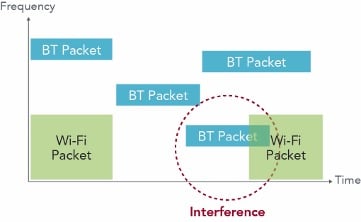
Making the case for Wi-Fi and Bluetooth radio coexistence
Wi-Fi and Bluetooth are complementary in many applications but have distinct functions, with Wi-Fi delivering high throughput connectivity and Bluetooth enabling low-power, low-latency connections. When designed into the same chipset, the two protocols are more likely to compete for available signal bandwidth, which introduces the potential for interference through radio leakage, spectrum contention and overlapping channel usage.
As a result, engineering teams want to understand how each technology performs in the presence of the other, not just in isolation. That means moving beyond traditional, single-standard validation toward real-world, concurrent performance analysis that reflects the way customers actually use devices: streaming music over Wi-Fi while connected to Bluetooth earbuds, or connecting a fitness tracker to the cloud while collecting local biometric data from a heart-rate sensor.
The argument for maintaining operational coexistence is easily defended. In practice, it’s becoming more challenging as Wi-Fi 7/8 and next-generation Bluetooth standards such as Bluetooth LE Audio evolve at different rates and along separate paths.
In these instances, current solutions are too expensive and require signalling test setups or analysers that are only able to operate above the physical layer (MAC and higher). Without test strategies that observe both radios in parallel and pinpoint the interactions between them, developers risk shipping products that stumble in exactly the mixed-use scenarios consumers care about most.
The importance of physical layer testing
The physical layer (PHY) is critical for providing root cause analysis of interference and performance degradation and for extracting parametric data that directly links to user experience outcomes. Test solutions that perform dedicated protocol-level analysis can cost hundreds of thousands of dollars but still lack PHY test capability.
That means engineers either over-invest in complex signalling systems that exceed the need for coexistence diagnostics or rely on protocol-only sniffers that can’t expose the root causes tied to RF behaviour. What’s needed is a targeted interference-detection test platform that captures and analyses concurrent Wi-Fi and Bluetooth traffic under realistic scenarios by correlating issues like audio dropouts with physical-layer conditions such as leakage, collisions, timing and channel overlap.
This approach keeps costs aligned with the problem scope while providing the depth of insight required to resolve coexistence issues before launch.
Future-proof coexistence testing with LitePoint’s IQsniffer
LitePoint’ IQsniffer PHY and MAC layer packet analysis tool fills this test performance gap with differentiated features that deliver:
- Detailed PHY-level measurements for Wi-Fi and all Bluetooth standards.
- Support for the proprietary Bluetooth data rates many chipset vendors rely on.
- A cost-effective alternative to full signaling test systems.
- A proven installed base that’s scalable across all leading chipsets.
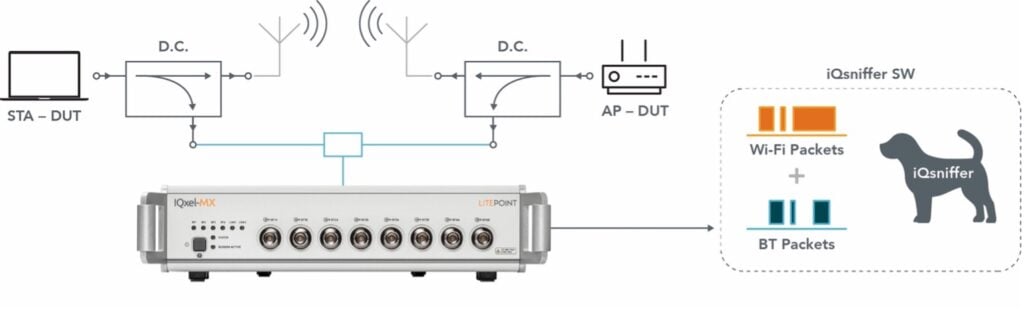
Customers value actionable insights into how PHY performance impacts device-level performance in real-world coexistence scenarios. IQsniffer provides PHY-level radio traffic analysis in mission mode without having to put devices in test mode with test firmware.
This allows engineering teams to correlate observable user-experience issues with measurable RF-domain metrics to reveal the problem – from signal leakage to a lack of adaptive frequency hopping implemented in software. In practice, IQsniffer addresses the essential criteria that designers rely upon during test and diagnosis, that is Capture Pinpoint and Evaluate (CPE)
- Capture: Real-world signal exchange between devices
- Pinpoint: Radio traffic issues in mission mode
- Evaluate: PHY-layer impact on device-under-test (DUT) system-level performance
As combo chipsets proliferate and spectrum overlap expands into the 5- and 6-GHz bands, the only sustainable way to preserve the user experience is to observe, measure and optimize at the physical layer while both radios are active. That makes coexistence testing between Wi-Fi and Bluetooth a mandatory tool in the test and quality assurance toolbox.
Comprehensive PHY-level testing is the best means to ensure interference-free performance, and LitePoint is uniquely positioned to deliver this capability, making wireless devices more reliable today and for what’s to come.
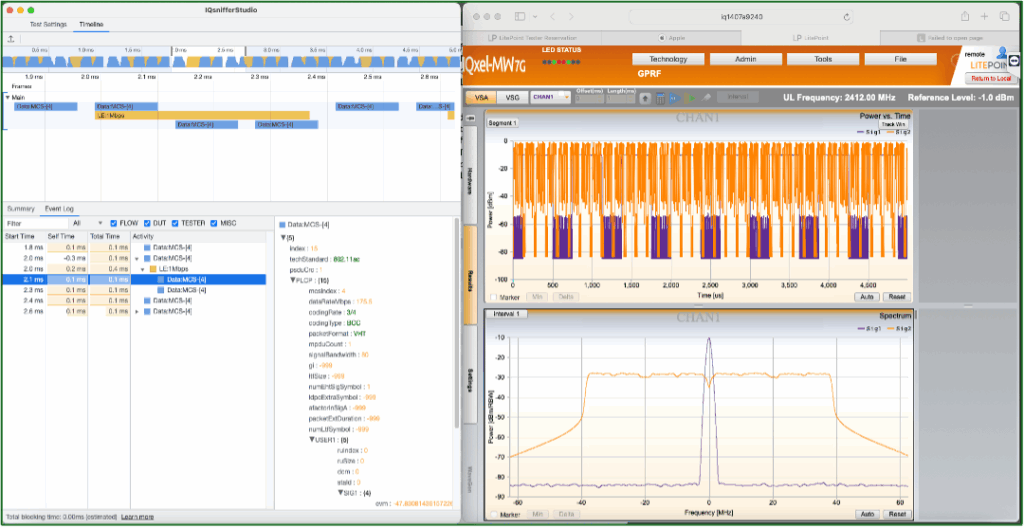
Rather than forcing engineers to choose between overpriced signalling tools and protocol-only analysers, LitePoint’s PHY-first approach focuses on the coexistence problem. IQsniffer helps developers anticipate and address interoperability issues before devices reach consumers, enhancing the user experience and helping device manufacturers accelerate time to market.
/Khushboo