New paper by LitePoint: Wi-Fi 8 physical layer dials up ultra high reliability features
| GUEST BLOG | by Claus Hetting, Wi-Fi NOW CEO & Chairman
This week’s guest author is Khushboo Kalyani, Product Marketing Manager at test & measurement leaders LitePoint. Khushboo frequently shares her Wi-Fi insights with WiFi NOW readers and is also a frequent contributor to Wi-Fi World Congress events. This paper is our first significant deep-dive into the reliability features of the next Wi-Fi standard, Wi-Fi 8.
When it was introduced by the Wi-Fi Alliance in January 2024, Wi-Fi 7 was notable for its extensive feature set – including UL-OFDMA, MLO, and 320-MHz channels. Yet, widespread deployment remains a challenge. Despite its potential, practical network implementation and consistent performance across the entire Wi-Fi 7 feature set has proved complex.
The release of Wi-Fi 8 (802.11bn) Draft 0.1 introduces a series of refinements designed to fine-tune and enhance these features and provides significant clarity on the physical layer characteristics designed to achieve Ultra High Reliability (UHR).
The upshot is that the IEEE appears to have deliberately introduced Wi-Fi 8 features aimed at fundamentally improving link resilience across varied channel conditions and enhancing overall reliability. Here, we will describe these features in greater detail within the context of three overarching categories – Robustness, Reliability, and Range.
Robustness equates to signal integrity and resilience while reliability indicates the probability of successful transmission
First, some housekeeping. It’s important to understand the distinction between Robustness and Reliability, as these terms are often used interchangeably. While both metrics enable high-quality communication, Robustness refers to signal integrity and resilience, or how well the signal maintains its quality and resists degradation from noise or interference under challenging channel conditions.
Reliability signifies the probability of successful transmission by ensuring data will be delivered to the receiver with minimal retransmissions. The understanding of their difference is vital to comprehending the impact of Wi-Fi 8’s new features and what they are designed to deliver.
Robustness: Rate adoption, transmission efficiency, and balancing power budgets
New Modulation and Coding Scheme (MCS) combinations
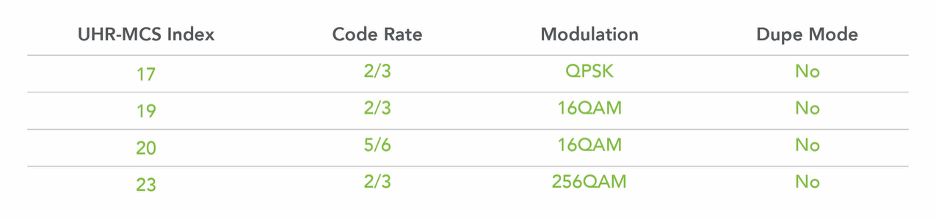
The new MCS combinations defined by Wi-Fi 8 are designed to enhance rate adaptation. While Wi-Fi 8 does not introduce entirely new modulation schemes, it significantly improves the resilience of existing ones. This is achieved by introducing lower code rates, which add redundancy to the transmission. Wi-Fi 7’s MCS 0-15 are carried over to Wi-Fi 8, with the addition of new indexes (17, 19, 20, and 23) for QPSK, 16QAM, and 256QAM modulations, as defined in the D1.0 draft specification.
The table above summarises the new UHR-MCS indexes.
Unequal Modulation (UEQM)
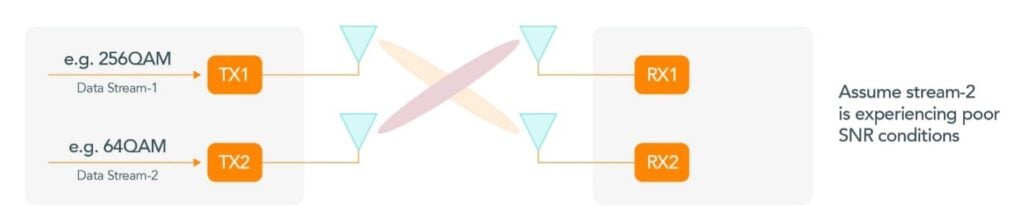
This feature enables the use of asymmetric modulation schemes across multiple spatial streams, primarily to enhance transmission efficiency in MIMO (Multiple-Input Multiple-Output) systems. Traditionally, MIMO transmissions apply the same modulation scheme across all spatial streams, irrespective of their individual channel conditions.
This often results in the overall data rate being limited by the weakest stream, as different streams may experience varying SNR conditions. UEQM addresses this by allowing different modulation orders to be applied to individual streams, adapting based on their respective channel conditions to optimise the overall transmission.
Tailoring modulation to the specific characteristics of each spatial stream.
Enhanced Long Range PPDU (ELR-PPDU)
IEEE introduced Enhanced Long Range Physical Layer Protocol Data Units (ELR-PPDUs) specifically for client devices within the UHR framework. The intent behind ELR-PPDUs is to mitigate the significant link budget imbalance between the uplink (UL) and downlink (DL).
A common challenge in Wi-Fi is that access points (APs) operate at much higher transmit power, making them easily heard by client devices. Conversely, client devices, due to their typically lower transmit power, are often “unheard” by the AP, especially at greater distances. This power disparity creates a link budget imbalance that severely impacts devices operating farther from the AP.
To address this, UHR introduces ELR-PPDUs, which are fixed-bandwidth (20 MHz) PPDUs designed for single spatial streams. These ELR-PPDUs can be used for both downlink and uplink operations in the 2.4-GHz band but are restricted to uplink-only transmissions in the 5-GHz and 6-GHz bands. To ensure extended range and reliability, these PPDUs employ lower MCS rates (specifically MCS 0 and 1) to minimize misinterpretation and errors.
Reliability: Resilience through extended error correction
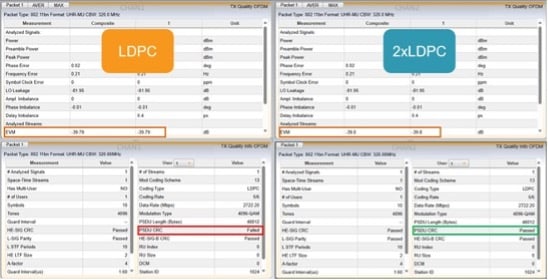
With UHR, IEEE has introduced a significant enhancement to forward error correction – longer low-density parity codes (LDPC) – with an extended codeword length of 3888 bits for station (client) devices. This effectively doubles the longest codeword length available in Wi-Fi 7, substantially improving the system’s ability to correct errors. LDPC codes are a mechanism that adds redundant or “parity” bits to the original data.
These extra bits enable the receiver to successfully correct errors that may occur during transmission, making the data more resilient to challenging channel conditions and significantly increasing the probability of successful decoding. This, in turn, helps avoid retransmissions. The added robustness is highly effective in noisy environments (poor SNR conditions), benefiting clients at the edge of an AP’s coverage.
The image above shows higher chances of passing CRC with 2xLDPC codes for a signal with EVM -39dBm.
Range: Expanding distribution of resource unit tones
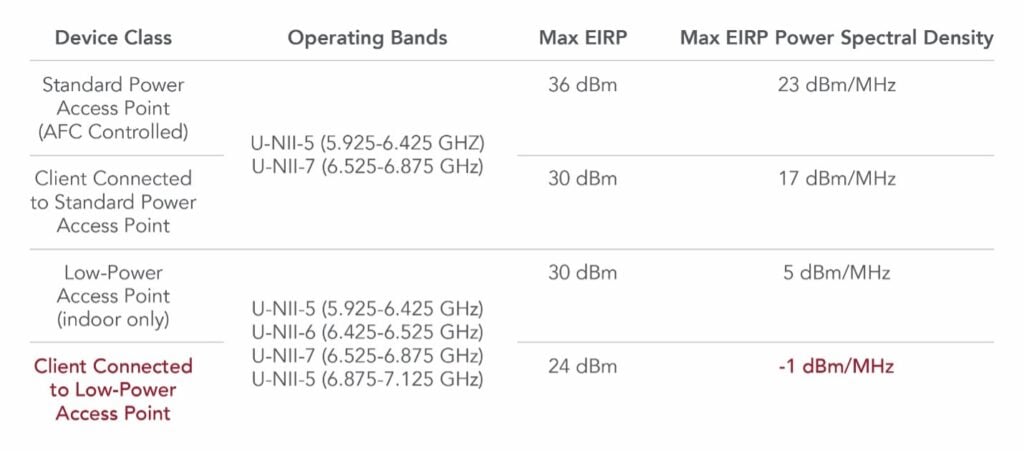
As the name implies, distributed Resource Unit (dRU) functionality extends tones over a larger bandwidth within a Wi-Fi network using technologies like OFDMA. To understand its significance, consider the background: In 2020, when the FCC opened the 6-GHz band for unlicensed use, it established strict transmit power guidelines for Wi-Fi APs and client devices to protect incumbent services.
Among these, Low Power Indoor (LPI) client devices face the tightest limit of -1 dBm/MHz Power Spectral Density (PSD). This stringent PSD requirement often limits uplink transmit range, creating an inherent uplink-downlink power imbalance where APs can easily be heard by clients, but clients struggle to reach distant APs reliably.
Summary of power requirements in the 6 GHz frequency band
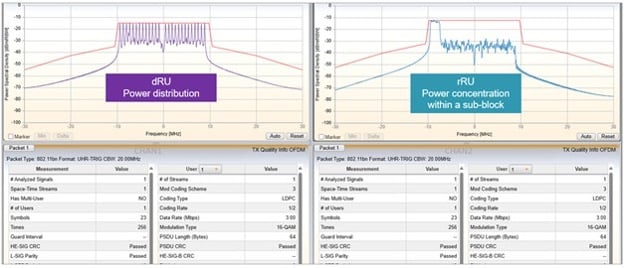
The dRU feature is designed for LPI client devices operating in the 6-GHz band and allows RU tones to be distributed over non-consecutive physical subcarriers, effectively reducing the number of tones per 1 MHz assigned to each station. This innovative approach enables devices to transmit higher uplink OFDMA power, which effectively extends transmission range without exceeding regulatory PSD requirements.
Power distribution of distributed (dRU) compared with regular RUs (rRU)
Summary: Wi-Fi 8 physical layer sets the stage for expanded coverage quality
Wi-Fi 8 physical layer features, though subtle, are meticulously designed to strengthen the three core pillars of wireless connectivity: robustness, reliability and range – attributes that profoundly impact the end-consumer experience. These features are optimized for both access points and resource-limited client stations, enhancing uplink range and connectivity and maximizing spectrum and resource utilisation.
This website uses cookies to improve your experience. Read more in our privacy statement. Accept
Privacy & Cookies Policy
Privacy Overview
This website uses cookies to improve your experience while you navigate through the website. Out of these, the cookies that are categorized as necessary are stored on your browser as they are essential for the working of basic functionalities of the website. We also use third-party cookies that help us analyze and understand how you use this website. These cookies will be stored in your browser only with your consent. You also have the option to opt-out of these cookies. But opting out of some of these cookies may affect your browsing experience.
Necessary cookies are absolutely essential for the website to function properly. This category only includes cookies that ensures basic functionalities and security features of the website. These cookies do not store any personal information.
Any cookies that may not be particularly necessary for the website to function and is used specifically to collect user personal data via analytics, ads, other embedded contents are termed as non-necessary cookies. It is mandatory to procure user consent prior to running these cookies on your website.

This week’s guest author is Khushboo Kalyani, Product Marketing Manager at test & measurement leaders LitePoint. Khushboo frequently shares her Wi-Fi insights with WiFi NOW readers and is also a frequent contributor to Wi-Fi World Congress events. This paper is our first significant deep-dive into the reliability features of the next Wi-Fi standard, Wi-Fi 8.